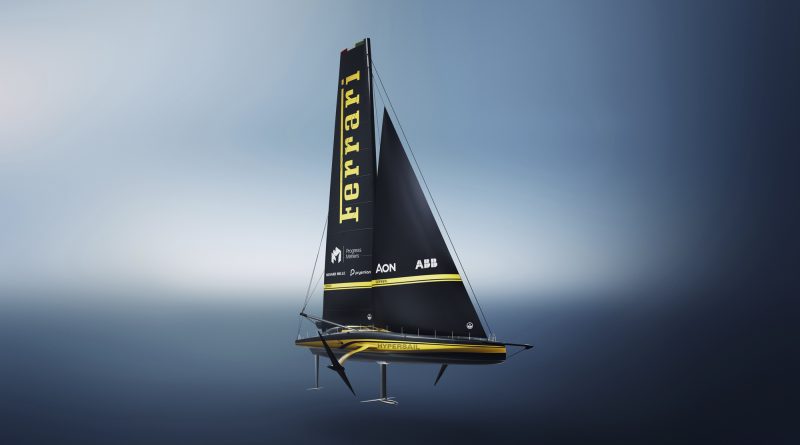
ABB and Ferrari Hypersail put 800 VDC marine power systems to the test
Subscribe to our free newsletter today to keep up to date with the latest transportation and logistics news.
ABB has joined Ferrari Hypersail as its electrification partner, bringing its marine power and direct current expertise to a 100-foot foiling yacht designed to operate entirely on renewable energy.
The partnership will focus on an onboard electrical architecture operating at 48V and 800 VDC. The system will generate, store and manage power for navigation, foil controls, safety systems and propulsion during extended periods at sea.
For ABB, the project also offers an opportunity to test advanced DC technology under severe offshore conditions.
Ferrari Hypersail will operate as a self-sufficient microgrid, balancing renewable energy generation, storage and power distribution while exposed to salt spray, constant motion, temperature changes and mechanical stress.
These conditions give ABB a demanding environment in which to assess how DC systems could support wider marine electrification.
“Ferrari Hypersail gives ABB a unique platform to demonstrate how we are collaborating with partners to push the limits of Direct Current technology,” said Giampiero Frisio, president of ABB’s Electrification business area.
Frisio said lessons from the project could help ABB develop more resilient and efficient power systems for sectors including marine and renewable energy.
Ferrari Hypersail will operate as a self-sufficient microgrid at sea
Ferrari Hypersail is designed to generate and manage its own energy for weeks at a time.
That requirement reflects a power challenge that is becoming more relevant across shipping.
Vessels are increasingly using batteries, hybrid propulsion systems, onboard renewable generation and more advanced electrical equipment. As these systems become more complex, operators need to manage how energy is generated, stored and distributed across the vessel.
Ferrari Hypersail takes that challenge to an extreme.
Its electrical system must support essential functions while the yacht remains independent of shore power. It must also respond quickly as operating conditions and power demand change.
“Hypersail runs entirely on renewable energy,” said Enrico Voltolini, project leader of Ferrari Hypersail. “It has to be self-sufficient for weeks at a time in the most hostile ocean environments on earth.”
ABB will support the project with expertise in DC system integration, intelligent power distribution, marine electrical systems and energy storage.
The use of DC is relevant because batteries and many renewable energy technologies operate using direct current.
In some applications, a DC architecture can reduce the number of conversion stages between generation, storage and onboard loads. Fewer conversions can reduce energy losses and simplify the integration of different electrical systems.
ABB says it has more than 25 years of experience in DC technology and holds more than 700 patents in the field.
The company has also spent more than a decade developing DC systems for commercial marine applications, including its Onboard DC Grid platform.
Extreme conditions could inform future marine systems
Part of the value of Ferrari Hypersail lies in the severity of its operating environment.
Marine electrical systems already need to withstand vibration, humidity, salt and changing power loads. A foiling ocean yacht adds further constraints around weight, space, system response and reliability.
Those factors make effective energy management especially important.
Ferrari Hypersail must continuously balance renewable generation, stored energy and electrical demand without access to an external grid. As a result, the way its systems work together is as important as the performance of individual components.
Commercial vessels have different operating profiles. A cargo ship, ferry or offshore support vessel will have different power requirements, safety standards and operating cycles.
Even so, many of the underlying engineering questions are becoming more familiar across the sector.
As shipowners add batteries, alternative propulsion systems and onboard renewable technologies, electrical architecture is becoming a more important part of vessel design.
DC distribution is one option receiving greater attention because it can support the integration of different energy sources within a common electrical system.
Ferrari Hypersail gives ABB a platform to study that process under unusually demanding conditions.
Marine electrification is becoming a system-level challenge
The wider significance of the partnership lies in what it may reveal about the development of marine electrification.
Shipping companies face growing pressure to cut emissions while maintaining reliability, range and operational flexibility. This is increasing interest in batteries, hybrid systems, fuel cells and other forms of onboard energy generation.
Adding those technologies is only one part of the task.
Vessels also need electrical systems capable of managing several power sources while maintaining a stable supply to essential equipment.
Ferrari Hypersail provides a compact example of that challenge.
Its onboard microgrid must combine renewable generation, storage and power distribution within a system where weight, efficiency and resilience all matter.
ABB will use its role in the project to study how those systems can be integrated and controlled during sustained offshore operations.
The findings will not transfer directly from a racing yacht to a commercial vessel. The scale, regulations and operating demands are different.
However, the project could still provide useful insight into how future vessels manage more complex electrical systems.
As shipping becomes more electrified, that system-level knowledge may become as important as the technologies used to generate and store power.
Source