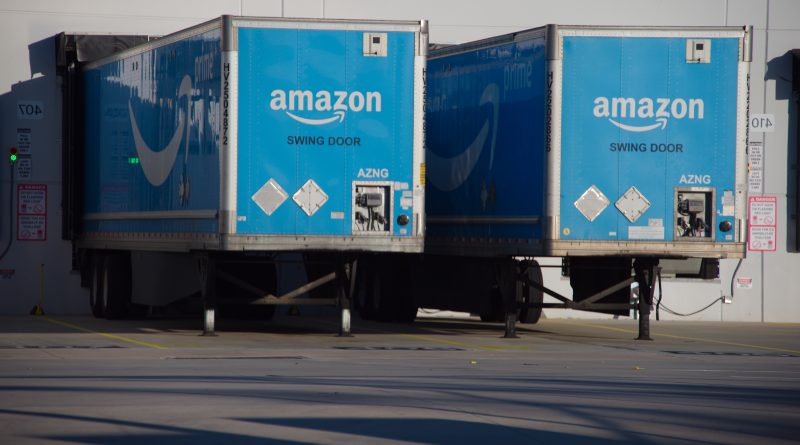
Amazon opens its freight network to businesses beyond its marketplace
Subscribe to our free newsletter today to keep up to date with the latest transportation and logistics news.
For years, Amazon built one of the world’s largest logistics operations to support its retail ambitions. What began as a network designed to move products through warehouses and into customers’ homes has evolved into a transportation ecosystem that rivals many established logistics providers in scale.
Now the company is taking another step in commercializing that infrastructure.
Amazon Supply Chain Services has launched a less-than-truckload (LTL) freight offering for businesses across the United States, including companies that do not sell through Amazon. The service allows shippers to access Amazon’s transportation network for palletized freight moving between warehouses, distribution centers, retail locations and other destinations.
The announcement reflects more than an expansion of transportation services. It highlights a broader shift in strategy as Amazon positions itself as a supply chain provider in its own right, creating new competitive pressure across the logistics sector.
Amazon is opening the logistics infrastructure it built for itself
Amazon’s logistics network has expanded rapidly over the past decade. As e-commerce volumes increased, the company invested heavily in fulfillment centers, transportation assets, delivery stations and software platforms capable of coordinating millions of shipments each day.
The latest freight offering forms part of Amazon Supply Chain Services, a division designed to make that infrastructure available to external customers.
The service focuses on less-than-truckload freight, a transportation model used when shipments do not require an entire trailer. LTL shipping plays a critical role for manufacturers, distributors and retailers moving smaller quantities of inventory between facilities. Instead of paying for a dedicated truck, multiple customers share trailer capacity, helping reduce costs and improve efficiency.
Amazon says its network includes more than 80,000 trailers and 24,000 intermodal containers, giving the company significant transportation capacity across the country. Businesses can use the service for shipments ranging from a single pallet to multiple pallets while accessing shipment visibility and tracking tools through Amazon’s platform.
The approach follows a familiar pattern. Rather than treating logistics solely as an operational necessity, Amazon is increasingly positioning its transportation infrastructure as a commercial service.
What the new LTL service means for shippers
Transportation remains one of the most volatile elements of supply chain management. Capacity constraints, fluctuating rates and limited shipment visibility continue to create challenges for businesses across multiple industries.
Amazon is seeking to address some of those concerns through technology-driven freight management supported by its existing logistics network.
Shipment visibility is central to the offering. Businesses can monitor freight through real-time tracking systems, while delivery verification and centralized transportation management tools provide greater oversight throughout the shipping process.
The service may be particularly attractive to small and medium-sized businesses that lack the freight volume needed to negotiate favorable contracts with large carriers. Access to Amazon’s network could provide transportation options that might otherwise be difficult or costly to secure.
Manufacturers and distributors may also benefit from increased flexibility when managing inventory flows between facilities. As supply chains become more responsive to shifting customer demand, transportation partners capable of adapting quickly are becoming increasingly valuable.
The value proposition is relatively simple. Instead of investing in transportation infrastructure, businesses can tap into a network built at national scale.
Why the logistics industry is paying close attention
The transportation sector responded quickly to the announcement.
Shares in several freight and logistics companies fell following the news as investors evaluated the potential impact of Amazon’s continued expansion into transportation services.
The reaction reflects growing recognition that Amazon is becoming a larger force across multiple areas of logistics.
Traditional transportation providers have spent decades building networks that support manufacturers, distributors and retailers. Amazon’s expansion introduces a competitor with substantial financial resources, advanced technology capabilities and a transportation footprint that continues to grow.
The immediate threat, however, may be less dramatic than some initial reactions suggest.
Industry analysts point out that Amazon’s current approach differs from many asset-based LTL carriers. The company still relies on brokerage relationships and external transportation partners to supplement portions of its network rather than operating entirely as a traditional trucking provider.
That distinction remains important because building and managing a fully integrated national freight network presents significant operational challenges, regardless of company size.
Even so, Amazon’s track record suggests that few sectors remain untouched once the company identifies a strategic opportunity.
Could logistics become Amazon’s next AWS moment?
Perhaps the most significant question raised by the announcement concerns Amazon’s longer-term ambitions.
When Amazon Web Services first emerged, it was widely viewed as an internal capability that supported the company’s growing technology requirements. Over time, AWS evolved into one of the world’s largest cloud computing businesses and reshaped an entire industry.
Some observers see similarities in Amazon’s logistics strategy.
The company initially built transportation infrastructure to support its retail operations. Today, that same infrastructure is being packaged and sold as a standalone service for external customers. In effect, Amazon is converting a major operational investment into a new source of revenue.
The comparison is not exact. Logistics involves physical assets, labor requirements, regulations and operational complexities that differ substantially from cloud computing. Yet the strategic logic remains familiar. Build infrastructure at scale, refine it through internal use and then open it to the market.
Whether logistics can become an AWS-sized success story remains uncertain. The freight industry is highly competitive, and incumbent providers benefit from decades of operational expertise and established customer relationships.
What appears increasingly clear is that logistics is no longer merely a supporting function within Amazon’s business model. It is becoming a growth engine in its own right.
For manufacturers, distributors and supply chain leaders, the launch of Amazon’s LTL offering represents more than another transportation option. It signals a logistics market that is becoming increasingly interconnected, technology-driven and competitive as new players seek to redefine how freight moves through the economy.
Source