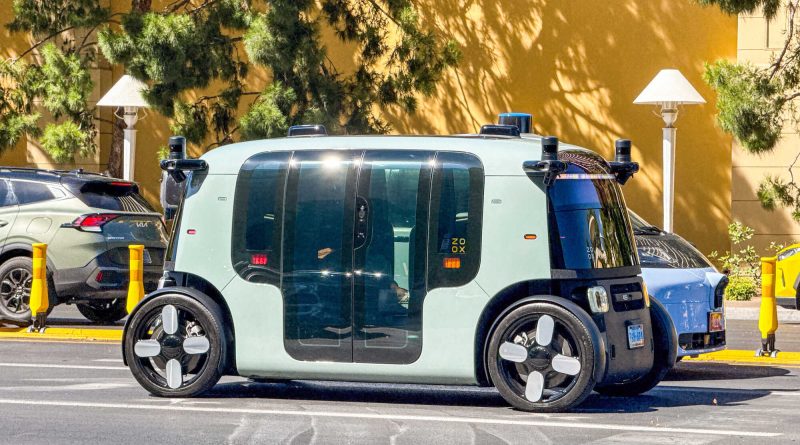
Amazon’s Zoox begins charging for robotaxi rides in Las Vegas
Subscribe to our free newsletter today to keep up to date with the latest transportation and logistics news.
Amazon-owned Zoox has spent more than a decade solving an engineering problem. Now it has to solve a business problem.
The autonomous vehicle company began charging passengers for robotaxi rides in Las Vegas on Aug. 10, turning a public service that had previously been free into its first commercial operation. The change appears simple from the passenger’s perspective. Open an app, request a ride and pay a fare. For Zoox, moving from demonstration to paid service changes the measure of success.
A free autonomous ride can be interesting enough to attract customers on novelty alone. A paid service competes for the same transportation budgets as taxis, ride-hailing services and other ways of moving around a city.
Zoox is entering that contest with one of the industry’s more unconventional vehicles. Its four-passenger robotaxi has no steering wheel or pedals, uses inward-facing seats and was designed from the outset for autonomous operation rather than adapted from a conventional passenger vehicle. In July, the company secured what it described as the first National Highway Traffic Safety Administration Part 555 commercial exemption for a purpose-built robotaxi.
The exemption gave Zoox federal clearance to charge passengers, subject to applicable state and local requirements. NHTSA’s wider Part 555 framework permits exemptions from certain federal motor vehicle safety standards and gives the agency scope to impose operating conditions and continuing oversight.
The regulatory milestone matters, but the harder test may start after approval.
A purpose-built robotaxi changes more than the driver’s seat
Most autonomous vehicle programs began with a familiar object: a conventional car fitted with sensors, computers and autonomous-driving software.
Zoox took another route. Its vehicle was developed around the assumption that no human would need to drive it. Removing the driver’s position creates freedom to rethink the cabin, passenger experience and direction of travel. The robotaxi can carry four people on two inward-facing benches and operate without the conventional controls created for a human driver.
That design is central to Zoox’s commercial argument.
A purpose-built vehicle could give an autonomous fleet operator greater control over the passenger environment and the relationship among software, hardware, maintenance and fleet operations. Zoox has gone further by retaining control over much of its operating system, including vehicle development, fleet infrastructure and customer experience. Axios characterized the model as a vertically integrated approach that asks the company to master several parts of the business at once.
That creates a potential advantage and an obvious burden. A company controlling more of the service can refine the product around autonomous transportation rather than work within a platform originally designed for human driving. It must then prove it can manufacture, maintain and operate that product economically at scale.
Zoox’s existing numbers show that the company has progressed beyond a small engineering exercise. Axios reported more than 3 million autonomous miles and nearly 1 million rides across its operations by early August. The same reporting said Zoox had built slightly more than 100 vehicles and eventually wants capacity to produce as many as 10000 a year.
Those figures illustrate the distance between validating a system and building a transportation network. Millions of miles can produce data about autonomous performance. A commercial service brings a different data set: revenue per vehicle, fleet utilization, maintenance costs, wait times, repeat use and customer willingness to pay.
Charging passengers creates a new standard for reliability
Zoox’s Las Vegas fare model gives an early indication of how it wants to position the service.
Reported pricing combines a base fare with time and distance. Zoox has targeted a level comparable with the comfort tier of conventional ride-hailing rather than using low prices to generate adoption. Riders are shown the price before booking, and destination-specific charges can be incorporated into the quoted fare.
That decision raises the commercial stakes.
Consumers paying a premium or near-premium fare have little reason to excuse poor availability, long waits or inconsistent service simply because the vehicle is autonomous. A paid robotaxi needs to work as transportation first and advanced technology second.
Zoox has already been adjusting the operational side of its service. In March, the company said it was introducing more precise arrival estimates, new pre-booking information and service changes intended to reduce waiting times. It reported more than 350000 riders and nearly 2 million autonomous miles at that point, months before the paid Las Vegas launch.
The progression reveals a familiar problem in industrial automation. Building technology that performs a task can be difficult. Turning it into a dependable operation introduces another set of constraints. Hardware availability, maintenance schedules, capacity, support systems and customer expectations start to matter alongside the core technology.
For Zoox, that distinction is now commercial rather than theoretical.
Regulation will shape how quickly one market becomes several
Federal approval does not create a national robotaxi network overnight.
Autonomous vehicle operators still face state and local rules, and Zoox has acknowledged that expansion requires engagement with regulators in individual markets. The company is testing and developing operations beyond Las Vegas, including San Francisco, Austin and Miami. Its own deployment process starts with mapping and conventional test vehicles before progressing through autonomous testing and purpose-built robotaxis.
Safety will remain part of that expansion debate. Zoox has published a safety framework covering the vehicle, autonomous-driving software and the people and processes supporting fleet operations. Axios noted an important distinction: publishing such a framework explains the company’s methodology but does not constitute independent certification that the system is safe.
That distinction matters as autonomous vehicle companies move from technical development toward wider commercial deployment.
Las Vegas gives Zoox a market in which those questions can now be tested against paying demand. The company has already demonstrated that passengers will enter a vehicle with no human driver and no conventional driving controls. Charging for the trip asks something more.
Customers now have to decide whether the experience is worth purchasing repeatedly. Zoox must keep enough vehicles available, deliver consistent trips, manage operating costs and satisfy regulators as it expands.
Amazon’s robotaxi investment has reached a point where technological progress alone is no longer the most revealing metric. Each paid ride now contributes evidence about whether the purpose-built approach can become an operating model rather than remain an impressive engineering achievement.
That may prove to be the more difficult autonomy problem.
Source