Amazon’s Zoox updates robotaxi ahead of US expansion
Subscribe to our free newsletter today to keep up to date with the latest transportation and logistics news.
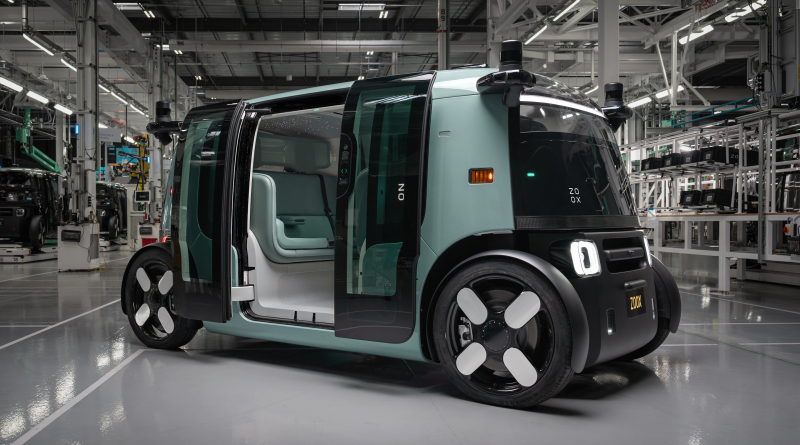
Amazon-owned autonomous vehicle developer Zoox has unveiled a redesigned version of its purpose-built robotaxi as it prepares to expand commercial operations in the US. While the latest updates focus on passenger comfort and vehicle usability, including improved seating, brighter displays and enhanced communication systems, the announcement is more significant for what it says about the state of the robotaxi industry than the vehicle itself.
The autonomous vehicle sector has spent much of the past decade trying to prove that self-driving technology can safely navigate public roads. That debate is beginning to fade. Instead, the leading companies are now competing on a different question: who can turn autonomous driving into a commercially viable transportation business?
Against that backdrop, Zoox’s latest vehicle offers an opportunity to assess where the company sits in an increasingly competitive market that is currently led by Alphabet’s Waymo.
Zoox is pursuing a fundamentally different robotaxi strategy
Founded in 2014 and acquired by Amazon in 2020, Zoox has taken a different approach from most autonomous vehicle developers. Rather than adapting existing passenger cars, it has designed an entirely new vehicle specifically for autonomous ride hailing.
The result is a compact electric shuttle with no steering wheel, pedals or traditional driver’s seat. Passengers sit face to face, while the vehicle’s symmetrical design allows it to travel equally well in either direction without needing to turn around.
The redesigned model unveiled this week refines that concept rather than reinventing it. The cabin now features more ergonomic seating, larger cupholders, brighter displays and improved audio systems, while external changes make it easier for pedestrians and passengers to distinguish the front and rear of the vehicle. Zoox has also strengthened communication systems between riders, remote operators and emergency responders, reflecting the practical demands of operating autonomous vehicles as a public transport service.
These are evolutionary improvements, but they signal that Zoox believes its design is approaching production maturity. The company says its Hayward, California, manufacturing facility is capable of producing up to 100 robotaxis each week once regulatory approvals allow broader deployment, supporting planned expansion beyond Las Vegas and San Francisco into Austin and Miami.
Waymo has changed what success looks like in autonomous driving
While Zoox continues preparing for commercial expansion, Alphabet-owned Waymo has already established itself as the benchmark for the robotaxi industry.
Unlike Zoox, Waymo has built its service around modified production vehicles supplied by automotive partners including Jaguar and Geely’s Zeekr. That decision allowed the company to concentrate on autonomous driving software and fleet operations instead of designing and manufacturing an entirely new vehicle.
More importantly, Waymo has moved beyond technical demonstrations. The company now operates one of the world’s largest commercial autonomous ride-hailing services, completing hundreds of thousands of paid passenger journeys every week across multiple US cities.
That scale changes the competitive landscape. Every journey helps improve not only Waymo’s autonomous driving software but also the operational side of the business, including dispatch, pricing, fleet utilisation, maintenance schedules and customer experience. Those commercial datasets become increasingly valuable as services grow because they improve the economics of operating large autonomous fleets.
In contrast, Zoox is still working toward that point. Its production ambitions remain tied to regulatory approvals that will allow its purpose-built vehicle, which lacks conventional driving controls, to operate at scale under US safety regulations.
The next stage of the robotaxi race will be won through execution
For much of the industry’s history, autonomous vehicle companies competed by demonstrating increasingly capable self-driving systems. Today, that is becoming only one part of the equation.
The companies most likely to succeed will also need to manufacture vehicles efficiently, navigate complex regulatory frameworks, deploy fleets across multiple cities and persuade passengers to adopt autonomous transport as an everyday alternative to conventional ride hailing.
Zoox’s strategy could ultimately prove well suited to that future. A vehicle designed specifically for shared mobility should, in theory, offer lower operating costs, more efficient use of interior space and a better passenger experience than one adapted from a privately owned car.
The risk is that commercial leadership can become self-reinforcing. As Waymo expands into more cities and completes more passenger journeys, it continues building operational expertise, refining its business model and strengthening public confidence in autonomous transport. Those advantages become progressively harder for competitors to replicate.
The redesigned robotaxi does not fundamentally change Zoox’s position in the market. It does, however, show that the company is moving closer to large-scale deployment. The bigger question is no longer whether Zoox can build an autonomous vehicle. It is whether Amazon can scale a robotaxi network quickly enough to challenge a rival that has already demonstrated commercial momentum.
Source
Photo credit