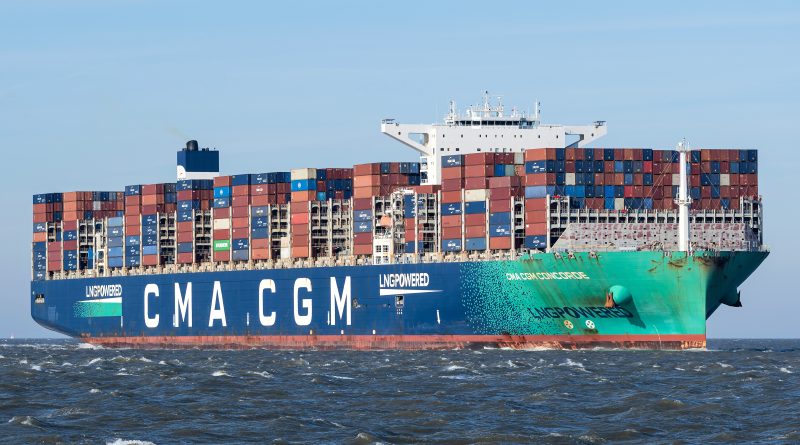
CMA CGM earnings show how fragile freight markets remain
Subscribe to our free newsletter today to keep up to date with the latest transportation and logistics news.
Global shipping entered 2026 expecting a gradual return to stability after years of supply chain disruption, inflated freight rates and geopolitical shocks. Instead, another crisis has emerged across one of the world’s most strategically important maritime corridors.
French shipping giant CMA CGM reported a sharp drop in first-quarter profit as conflict involving Iran disrupted shipping activity across the Gulf, increased operating costs and added fresh uncertainty to global trade flows. The company’s results also highlighted a broader problem facing the container shipping industry. Even major geopolitical disruption is no longer producing the extraordinary earnings carriers enjoyed during the pandemic-era freight boom.
The world’s third-largest container shipping company reported EBITDA of $2.11 billion for the quarter, down from $3.09 billion a year earlier. Net profit fell to $250 million from $1.12 billion. Revenue remained broadly flat at $13.23 billion, though shipping revenue declined 8.5% while logistics revenue rose 6.6%.
The numbers underline how rapidly conditions have changed for global carriers. Shipping lines are now operating in a market where operational risk continues rising while pricing power weakens.
The Iran war is reshaping maritime trade economics across the Gulf
The conflict involving Iran has quickly become one of the most disruptive geopolitical events facing maritime trade since the Red Sea crisis intensified in 2024. The Strait of Hormuz remains one of the world’s most critical shipping chokepoints, handling a substantial share of global oil exports and containerized trade linked to Gulf economies.
For container carriers, the impact extends beyond delays. Shipping companies are facing rising marine insurance premiums, elevated fuel costs, security concerns and increasingly complicated routing decisions. Vessel operators must now balance commercial schedules with rapidly shifting security assessments.
CMA CGM experienced those risks directly this month when one of its container vessels was attacked while transiting the Strait of Hormuz. Crew members were injured and the ship sustained damage. Another company vessel exited the Gulf amid growing regional instability.
The incident reinforced concerns already circulating across shipping markets. Maritime security analysts and insurers have warned that commercial vessels operating near the Gulf face heightened exposure to drone attacks, missile strikes and military escalation linked to regional conflict.
In response, carriers are redesigning networks to maintain cargo flows into Gulf markets while limiting exposure to dangerous routes. CMA CGM said it had established alternative transport links to continue serving customers across the region despite operational constraints.
Those adjustments carry significant costs. Longer routes increase fuel consumption, reduce schedule reliability and complicate equipment management. At the same time, shippers are becoming more cautious about inventory planning as transit reliability weakens again.
Why weaker freight markets are offsetting geopolitical disruption
Historically, geopolitical shocks in shipping have often pushed freight rates sharply higher, allowing carriers to offset disruption with stronger pricing. Current market conditions are proving different.
Container shipping demand has softened compared with the post-pandemic surge that transformed industry profitability between 2021 and 2023. Global consumers and manufacturers have reduced inventory accumulation, while economic uncertainty across Europe and parts of Asia has weakened import demand.
At the same time, carriers continue absorbing substantial new vessel capacity ordered during the pandemic boom years. The influx of larger container ships has intensified competition across major trade lanes and limited carriers’ ability to sustain elevated pricing.
As a result, freight market volatility no longer guarantees stronger earnings.
That dynamic is becoming increasingly visible across the industry. Carriers face rising operational costs linked to conflict and rerouting, yet weaker demand conditions prevent those costs from being fully passed through to customers.
The result is margin compression across large parts of the shipping sector.
CMA CGM’s quarterly performance reflected that pressure. Although the company maintained relatively stable overall revenue through logistics growth, weakness in core shipping operations weighed heavily on profitability.
Industry executives are also confronting a more complicated planning environment than they faced during earlier supply chain crises. The pandemic period produced unusually strong consumer demand and constrained capacity simultaneously. Today’s market combines geopolitical disruption with softer trade conditions and excess fleet capacity.
That combination leaves carriers more vulnerable to prolonged volatility.
Logistics diversification is becoming the industry’s financial buffer
One of the clearest trends emerging from CMA CGM’s earnings was the growing importance of logistics diversification.
While shipping revenue declined during the quarter, the company’s logistics business continued expanding. That shift reflects a wider strategic transformation underway across the global container shipping industry.
Major carriers increasingly view logistics, warehousing, air freight and supply chain management services as essential buffers against volatility in ocean freight markets. Companies are attempting to evolve from pure shipping operators into integrated logistics providers capable of generating more stable earnings across economic cycles.
CMA CGM has invested heavily in that transition in recent years through acquisitions, air cargo expansion and broader supply chain capabilities. Rivals including Maersk and MSC have pursued similar strategies as competition intensifies across container shipping.
The logic behind the shift is becoming clearer with each geopolitical shock.
Ocean freight remains highly cyclical and vulnerable to sudden swings in rates, fuel prices and global demand. Logistics services, while not immune to economic slowdown, can provide more diversified revenue streams and closer customer relationships.
For shipping groups facing mounting uncertainty, that diversification is increasingly less about growth and more about resilience.
Shipping executives are preparing for a longer period of uncertainty
The industry outlook remains difficult to predict.
Oil prices continue fluctuating as markets assess the risk of deeper regional escalation involving Iran and potential disruption to Gulf energy exports. Insurance costs for vessels operating near conflict zones are rising again. Trade policy uncertainty, including tariff disputes and regional industrial policies, continues reshaping global cargo flows.
At the same time, carriers must manage environmental regulation, overcapacity concerns and slowing economic growth across several major economies.
CMA CGM adopted a cautious tone in its outlook, warning that visibility remains limited due to geopolitical instability and market volatility. That caution is spreading across the industry.
Shipping executives increasingly appear to be preparing for a prolonged period in which disruption becomes a structural feature of global trade rather than a temporary shock.
For an industry built around efficiency, predictability and scale, that may prove the most significant challenge of all.
Source