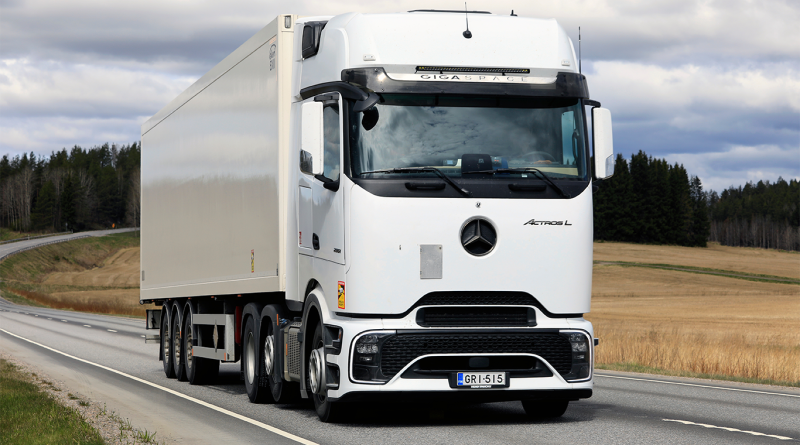
Daimler Truck sees 26% sales growth despite electric slowdown
Subscribe to our free newsletter today to keep up to date with the latest transportation and logistics news.
Daimler Truck reported a 26% increase in third-quarter 2026 vehicle sales, driven by a substantial recovery in North America and improved performance at Mercedes-Benz Trucks. The results suggest strengthening demand in two of the manufacturer’s largest markets, although declining battery-electric vehicle deliveries highlight the uneven progress of commercial vehicle electrification.
The German commercial vehicle manufacturer sold 91,260 vehicles during the quarter, compared with 72,277 in the corresponding period of 2025. North American deliveries increased 51%, while Mercedes-Benz Trucks recorded growth of 13%, reinforcing expectations of stronger financial performance during the second half of the year.
The improvement follows a challenging period for commercial vehicle manufacturers facing uncertain freight demand, changing trade policies and pressure on operating margins. Yet the recovery was not universal, with Daimler Buses reporting a 16% decline in deliveries and battery-electric truck and bus sales falling 28%.
North American demand drives Daimler Truck’s sales recovery
North America made the largest contribution to Daimler Truck’s third-quarter growth, with regional vehicle sales increasing to 45,629 units from 30,225 a year earlier. The 51% rise represents a significant improvement in a market where Freightliner and Western Star serve customers across long-haul transportation, construction, distribution and specialized industrial applications.
The increase comes as fleet operators continue adjusting to changes in transportation demand, equipment costs and commercial vehicle ownership economics. Purchasing decisions in the heavy-duty truck market reflect expectations for freight volumes, financing conditions, maintenance expenses and the operating efficiency of newer vehicles.
For manufacturers, stronger demand can improve factory utilization and provide greater visibility over production requirements. More predictable manufacturing schedules can support inventory management and purchasing efficiency, although the financial benefits depend on production costs, pricing and vehicle mix.
Daimler Truck’s performance indicates that deliveries have strengthened, but rising sales do not necessarily demonstrate an equivalent improvement in new orders. Vehicle deliveries can reflect purchasing decisions made during previous quarters, making future order intake an important indicator of whether the recovery can continue.
The results support the more optimistic financial expectations outlined in August, when Daimler Truck raised its full-year 2026 adjusted earnings before interest and taxes forecast to between €3.6 billion and €4.1 billion, compared with its previous projection of €3.2 billion to €3.7 billion.
The company increased its expected annual vehicle sales to between 340,000 and 370,000 units, while raising the North American segment’s projected adjusted return on sales to between 9% and 11%, compared with its previous forecast of 6% to 8%.
Improving demand and reduced anticipated tariff exposure contributed to the revisions, reflecting management’s confidence that stronger vehicle deliveries could support profitability during the remainder of 2026.
European truck sales improve as electric deliveries decline
Mercedes-Benz Trucks reported third-quarter sales of 40,362 vehicles, an increase of 13% from 35,818 during the corresponding period last year. The improvement comes amid signs of recovery across European commercial vehicle markets, where purchasing activity has strengthened following a period of relatively weak demand.
According to the European Automobile Manufacturers’ Association, new EU truck registrations increased 9.8% during the first six months of 2026 to 171,933 vehicles, supported by an 11.1% rise in heavy-truck registrations.
The recovery varied between countries, with Poland recording growth of 25.9%, followed by Spain at 13.2% and Germany at 7.1%. These figures indicate improving regional market conditions, although European registrations and Mercedes-Benz Trucks’ worldwide deliveries are not directly comparable.
Daimler Truck’s stronger conventional vehicle sales contrasted with declining battery-electric deliveries. The manufacturer sold 1207 battery-electric trucks and buses during the third quarter, compared with 1679 a year earlier, representing a 28% decrease.
Battery-electric vehicles accounted for approximately 1.3% of total quarterly deliveries, down from 2.3% in the corresponding period of 2025. The decline contrasts with the wider European market, where registrations of electrically chargeable trucks increased 47.7% during the first half of 2026, according to the European Automobile Manufacturers’ Association.
The different results highlight the complexity of commercial vehicle electrification, particularly as manufacturers and fleet operators assess the financial and operational implications of adopting new powertrain technologies.
Heavy-duty truck operators must consider charging infrastructure, electricity prices, vehicle acquisition costs and the practical requirements of maintaining demanding transportation schedules. These calculations differ considerably between urban distribution fleets operating on predictable routes and long-distance haulage businesses requiring extensive charging networks.
Daimler Truck continues investing in its electric commercial vehicle portfolio, including the Mercedes-Benz eActros range, but its latest figures demonstrate that product development does not automatically translate into consistent sales growth.
The company’s bus operations experienced a separate decline, with quarterly deliveries falling to 5394 vehicles from 6443 a year earlier, reflecting difficulties in markets including Latin America and Mexico.
Stronger sales leave Daimler facing further market uncertainty
Daimler Truck’s recovery provides an encouraging development for commercial vehicle manufacturing, particularly as producers navigate changing freight demand, trade regulations and the financial requirements associated with alternative powertrains.
The manufacturer’s revised outlook anticipates industrial business revenue of between €43 billion and €47 billion in 2026, alongside an adjusted return on sales of 7% to 9%. Industrial business free cash flow is projected at between €3 billion and €3.5 billion, reflecting expectations of improved operating conditions.
These forecasts remain dependent on assumptions surrounding regional demand and trade regulations. Daimler Truck stated that its updated guidance assumes the existing United States-Mexico-Canada Agreement framework remains in place, with potential tariff changes representing a source of financial uncertainty.
The company’s approved US content application improved its expected tariff position, but future regulatory developments could influence manufacturing expenses, component sourcing and investment decisions across North American production networks.
Its revised reporting structure also affects historical comparisons. Following Mitsubishi Fuso Truck and Bus Corporation’s integration into ARCHION on April 1, 2026, Daimler Truck’s reported vehicle sales reflect continuing operations rather than the group’s previous business structure.
During the first nine months of 2026, Daimler Truck sold 246,816 vehicles, an 8% increase from the comparable continuing-operations figure of 228,642 in 2025. The difference between year-to-date growth and the stronger third-quarter performance indicates that sales accelerated during the latest reporting period.
Daimler Truck is scheduled to publish its third-quarter financial results on November 6, providing further insight into whether higher deliveries have translated into improved margins and cash generation.
With North American demand recovering and Mercedes-Benz Trucks recording stronger sales, Daimler Truck enters the final quarter with improved commercial momentum. Sustaining that performance will depend on continued fleet investment, disciplined manufacturing costs and the company’s ability to manage the financial demands of commercial vehicle electrification.
Source:
Global Banking & Finance Review