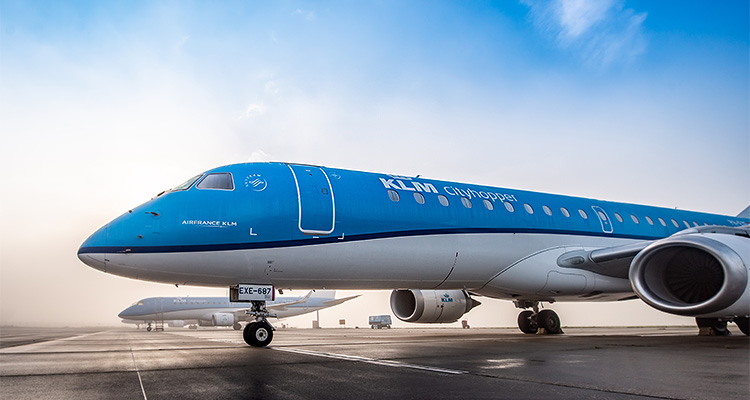
Flying at the forefront of innovation for the KLM group, KLM Cityhopper is a pioneer in sustainable aviation
From its first hop across the channel to a bustling international network, KLM Royal Dutch Airlines (KLM) has been shaping aviation history for more than a century. Found-ed in 1919, KLM holds the remarkable title of the world’s oldest airline still operating under its original name, with its inaugural flight taking off from London to Amsterdam in 1920. Since then, it has expanded intercontinental routes, embraced innovation, and grown into a defining force in European aviation.
KLM Cityhopper is, perhaps, the most important airline operating in the UK outside of London. Headquartered on the grounds of Amsterdam Airport Schiphol in Havenmeesterweg, The Netherlands, KLM Cityhopper allows passengers to unlock a European network of over 75 destinations right from their doorstep: from Vienna to Prague, Barcelona to Berlin, Bergen, Belfast, and beyond.
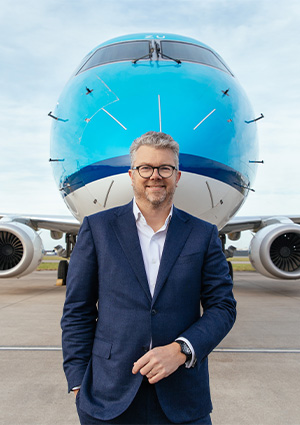
Last year was a busy year for KLM Cityhopper; the company commenced its major fleet modernization program and announced new destinations, including Exeter (UK), Ljubljana (Slovenia), and Biarritz (France). Now, 2026 marks a particularly special year for KLM Cityhopper: its 60th anniversary. In light of this milestone, Transportation & Logistics International sits down for an exclusive interview with Maarten Koopmans, Managing Director of KLM Cityhopper, to learn more about the company’s dynamic investment program and pioneering environmental stewardship.
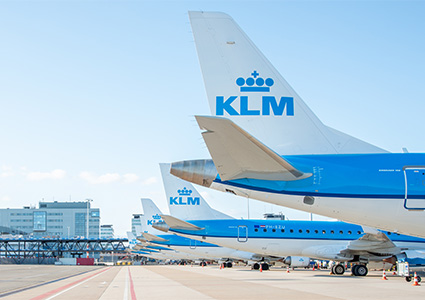
Maarten begins our conversation by introducing the company’s journey thus far. “KLM Cityhopper is a wholly owned subsidiary of KLM, so we’re a part of the group but are an independent operating carrier. We began operations in 1966 with two aircraft and a handful of domestic flights, but over the last 60 years we’ve acquired businesses – such as Air UK in 1996 – and grown to become an important feeder for KLM’s International Hub,” he shares. “Today, we fly 100 percent Embraer aircraft and are Embraer’s largest European customer, operating 63 aircraft comprising E-175s, E-190s, and E-195-E2s. We operate more than 400 flights per day, bring over ten million passengers to their destinations every year, and fly to 75-plus European destinations each summer. We act as an innovation lab for KLM since our scope is a little smaller; if the group wants to test something new, KLM Cityhopper is there to help.”
The company’s evolution has been underpinned by a clear strategic focus on efficiency, innovation, and adaptability. As KLM Cityhopper has grown into a vital component of KLM’s network and a testing ground for new ideas, it has continued to reinvest in operations – in particular, its fleet. The company boasts the most modern regional fleet in Europe and is constantly reinvesting where others don’t to ensure that it’s operating the most sustainable and commercially viable aircraft. In particular, KLM Cityhopper has invested significantly in Embraer’s newest aircraft: the Embraer 195-E2 – an upgrade from its existing E-190 aircraft.
“While we are a regional carrier flying somewhat smaller aircraft, we are still a large operation in terms of the number of flights we do and the number of aircraft we have, which means that we have to be very well structured and organized,” Maarten elaborates. “While many of our aircraft are still fairly young, we have decided that it’s time to go for the newest Embraer aircraft, the 195-E2. We already have 25 of them in our fleet and intend to expand that further.
“When the 195-E2s came from the factory, they initially had 132 seats, but we decided to reconfigure them to 136 seats. We’re currently in the midst of that process while keeping to the standards that we have for both economy and business class passengers in terms of space. It marks an important investment for us.”
As Maarten details, KLM Cityhopper’s strategic investments are centered around operational efficiency, customer satisfaction, and sustainability. The introduction of the 195-E2s demonstrates this focus. However, fleet modernization is just one factor of the wider picture, as the company has also been investing heavily in the electrification of its ground equipment. Most notably, KLM Cityhopper became the world’s first airline to sell tickets with a 100 percent SAF-surcharge, setting a new benchmark for environmentally responsible aviation.
“Sustainability is an important subject for the KLM group; it’s embedded in our strategy to be a pioneer in that field. We see it as our responsibility to make our flights as sustainable and viable as possible, which is why we are introducing the 195-E2. A lot of our competitors use the E-190, which is a great, fuel-efficient aircraft, but the 195-E2, in comparison, is around 60 percent quieter and 30 percent more fuel efficient per seat,” Maarten explains. “We are right at the forefront of new fleet upgrades, which is the most important thing; the oldest aircraft that we’ve exchanged was only 15 years old. In addition, more than 70 percent of all our ground equipment has been electrified.
“With KLM Cityhopper being a testing ground for the wider group, we can spearhead different tools, such as the OptiClimb system, which utilizes artificial intelligence to calculate the most efficient climb profile. Additionally, KLM Cityhopper won the prestigious Pioneer of the Year award for its 100 percent SAF ticket project, which ran in 2025 on the Amsterdam – London City Airport and Amsterdam – Hamburg routes. KLC temporarily sold tickets with a SAF percentage of 100 percent on the two test routes. The additional SAF contribution went entirely towards the purchase of SAF. In this way, KLC investigated passengers’ willingness to pay extra for SAF if it’s included in the ticket price as standard. We’re always trying to push the boundaries when it comes to sustainability.”
Summer 2026
With the seasons changing, KLM Cityhopper is gearing up for the busy summer period. For summer 2026, the company is expanding its geographic reach even further with the introduction of three new exciting destinations: Jersey, Oviedo (Spain), and Santiago de Compostela (Spain). As KLM Cityhopper continues to grow, its future remains focused around operational efficiency and great service, and the company is set to take further steps in SAF and sustainability.
“We fly upwards of 400 flights every summer and form a large part of KLM’s European network, so our main goal for this year is to see how we can make our operation more robust. It’s super important for us to work hard and deliver on-time performance for KLM,” Maarten reveals.
“In five years, we will have an even more modern fleet than we have today, with the 195-E2 being our main aircraft then. We have a very stable operation at Schiphol and will continue to be the feeder for KLM’s European network. We are constantly investing in our operational base and have firm sustainability targets in place to decrease the use of gas on the ground by electriåfying more equipment. By 2030, I expect that we’ll have delivered almost all those goals and have taken some significant steps in SAF.
“Above all else, KLM Cityhopper is committed to delivering a great service to all our customers,” he concludes, reflecting on the company’s most important asset. “I’m very proud of the staff that we have, many of whom are fairly young, so I’m particularly happy to see how they are coping with that extra responsibility at an early time in their career. Our customers respond very well to our team and I’m confident that we can maintain that as our greatest strength.”