
Founded on service excellence, Lux Express transforms long-distance bus travel into a premium experience
Boasting a fleet of over 100 buses, Lux Express (Lux) is a long-distance coach service provider that prides itself on incredibly high standards of service during both administration and journey. Lux was formed in Estonia in 2008, with company operations dating back as far as 1994, shortly after the company regained independence from the Soviet Union in 1991. CEO, Ingmar Roos, explains how this affected Lux’s trajectory at the beginning, steering its focus towards international operations on long routes, and reveals more about the company’s expansion and plans for 2026: “The first route we started was Tallinn, Estonia to Stuttgart, Germany, which seems absurd these days! We’re no longer focusing on those extremely long routes, but for the first 15 years the company was a partner of the Eurolines brand, a cross-operator brand for ticket distribution. Various operators from different countries had joined together at their route networks and Lux used to be the Estonian, Latvian and Lithuanian partner. However, the emergence of the cheap airlines business model in the early 2000s, along with the continuous degradation of Eurolines’ brand strength, made this very difficult to sustain – travel to Western European destinations fell rapidly due to airlines providing a faster, more affordable alternative. The philosophy behind establishing the Lux brand was to build a bus service that goes above and beyond the conventional bus service. We wanted to totally reinvent the idea people had of these dull metal boxes, essentially made for carrying people, and our aim was to make the bus service as attractive as possible by using the total renewal service concept.”
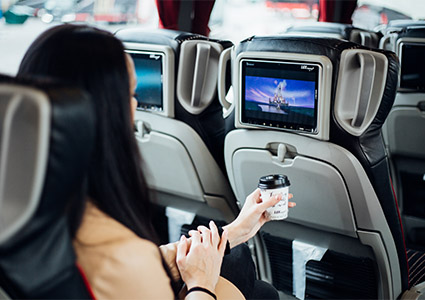
With its bus fleet selection being crucial to the company’s growth, Lux began an important collaboration with top strategic partner Irizar, selecting buses based on engineering, cost effectiveness and appearance. “As airlines started to affect our business, we realized we needed to copy best practice in the aviation industry in terms of dynamic pricing and yielding, but the exterior and interior design of the bus was also highly important to us. We focus on routes of up to 500 kilometers and ensuring the comfort of a Lux bus results in time well spent for our customers. From day one, we went for the very expensive solution of having personal media screens on all the seats, Wi-Fi, and hot drinks free of charge on the buses, which at that time was revolutionary. Another primary focus within our services is the hospitality provided by the driver and all our employees – we believe our passengers should feel like impeccably served guests. They should be treated in a friendly and helpful way with their needs considered. We pay careful attention to our customers, introducing our drivers, availabilities and features of the bus, also letting them know that help is available if they have any issues. Equally, we are very protective of our property and any damage or disrespect to the buses will not be permitted. All that is the foundation of the service concept, and it has allowed us to distinguish ourselves from other providers.
“I am confident that in Estonia, a tiny country in Northeastern Europe, we have done more than any other service to attract people to use the bus instead of a car. We also like to emphasize our service targets people who want to use their time and money wisely by taking the bus instead of driving a private car. To quote the well-known sentiment of a mayor in Santiago, Chile; ‘An advanced city is not one where even the poor use cars, but rather one where even the rich use public transport.’ This is very indicative of the Lux mindset, because I think cars are our number one competitor.”
Neoplan Skyliner project
Recent investments include Lux’s Neoplan Skyliner project, which has introduced double-decker buses to its fleet, and has been responsible for an increase in passenger flow and revenue. This addition allows Lux to achieve up to 40 percent higher capacity while also providing a fresh service for its concept.
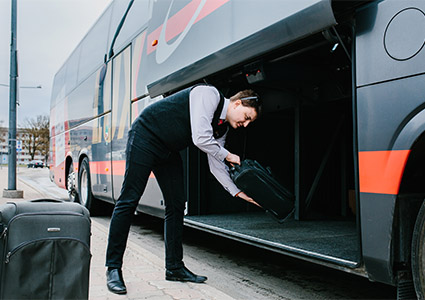
When it comes to ticketing, Lux sells 89 percent of tickets through web shops, most significantly through its own platform Lux Express EU, alongside aggregators, such as Omio.com. “The share of sales via self-service ticket machines is very small in comparison,” continues Ingmar. “But these sales are still very important in providing our customers with that option. Ticket sales are also available onboard – although it isn’t the usual pattern for long-distance travelers to show up and ask for ‘one ticket to Warsaw please!’ Essentially, the emergence of online channels is integral to ticket sales, and I think starting sales through our own web shop in 2001 was key. Continuing our focus on digital sales and marketing is a priority going forward.”
Further priorities for the company over the next three to four years revolve around growth in Scandinavian countries, following its first significant franchise contract last year – expanding the Lux brand to Finland. “We began delivering Finnish domestic routes, which was a big achievement for Lux and fantastic recognition of our work, commencing an agreement with the biggest long distance bus operator in Finland,” Ingmar concludes. “As well as moving into Sweden and Norway, we’re also looking at onboarding some partners in the southern parts of Poland. I believe public transport services can only achieve a modal shift if you highlight their qualities. Of course, you can never have the same door-to-door approach you get with car usage, but by providing a travel experience where you can spend time consuming entertainment, working, or simply taking time to rest instead of driving, you can achieve a better quality of journey. All this combined means Lux is in a very good position at present.”