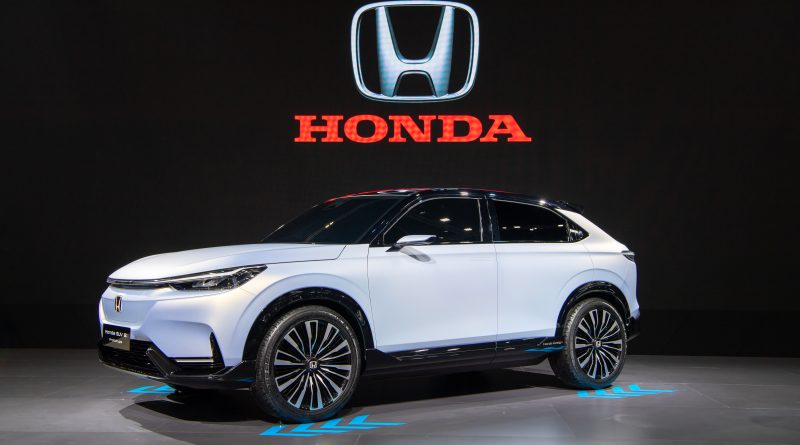
Honda’s EV retreat exposes the cost of moving too fast
Subscribe to our free newsletter today to keep up to date with the latest transportation and logistics news.
Honda spent much of the past decade warning investors that the auto industry was approaching its largest transformation in more than a century. Electric vehicles were expected to dominate future sales, governments introduced aggressive emissions targets and established manufacturers faced pressure to match the rapid growth of Tesla and China’s BYD.
Honda has now become one of the clearest examples of how quickly that strategy changed.
The Japanese automaker reported its first annual loss since becoming a publicly traded company, driven largely by restructuring costs tied to electric vehicle investments and canceled development programs. The company expects total EV-related costs and write-downs to approach $16 billion as it reassesses several major projects across North America.
The reversal marks a sharp change for a manufacturer that once positioned electrification at the center of its long-term strategy. Honda pledged to phase out gasoline-powered vehicle sales by 2040 and aggressively expand battery production capacity in North America. Only a few years later, executives are scaling back those ambitions and redirecting investment toward hybrid vehicles.
The shift reflects a broader recalibration across the automotive sector. Demand for electric vehicles continues to grow globally, though not at the pace many manufacturers projected during the post-pandemic boom. Higher borrowing costs, uneven charging infrastructure and weaker consumer demand in some Western markets created financial pressure for companies that committed billions to rapid EV expansion.
For Honda, the timing proved particularly difficult.
Honda’s aggressive EV expansion collided with a changing market
Honda entered the EV race later than several rivals, increasing pressure on management to accelerate development timelines. The company announced major investments in battery technology, dedicated EV platforms and North American production facilities while preparing a new generation of electric models under its 0 Series brand.
That strategy depended on sustained growth in EV adoption rates, particularly in the US market.
Consumer demand softened just as production costs remained elevated. Several automakers found buyers still preferred hybrid models over fully electric vehicles, especially outside premium segments. Financing costs climbed as interest rates rose, making EV purchases less attractive for middle-income consumers.
Political uncertainty complicated long-term investment planning. Potential changes to US tax incentives and industrial policy created additional risk for manufacturers building large-scale battery supply chains in North America.
Honda responded by canceling several planned electric models, including projects tied to its North American rollout. The company also suspended development activity connected to a major Canadian EV and battery investment initiative.
The financial impact became severe enough to push Honda into an annual net loss estimated at roughly $2.7 billion.
The reversal highlights a difficult reality for legacy automakers. Developing electric platforms requires enormous upfront spending years before meaningful returns appear. Manufacturers must invest simultaneously in software systems, battery sourcing, factory upgrades and charging partnerships while still maintaining profitable gasoline and hybrid operations.
For companies without Tesla-level scale or Chinese manufacturing advantages, the economics remain difficult.
China and software-driven competition exposed deeper weaknesses
Honda’s challenges extend beyond slowing EV demand in North America.
China, once one of the company’s most important growth markets, became increasingly difficult for foreign automakers. Domestic manufacturers led by BYD expanded rapidly by combining lower production costs with faster software development and aggressive pricing strategies.
Traditional Japanese automakers struggled to compete in that environment.
Chinese consumers increasingly expect vehicles to function as integrated software products with advanced driver interfaces, entertainment systems and connected services. Domestic manufacturers adapted quickly to those preferences while benefiting from strong government support and highly localized supply chains.
Honda’s sales performance in China weakened sharply as local competitors gained market share.
The problem is structural as much as cyclical. Legacy manufacturers historically built their competitive advantage around engineering quality, manufacturing efficiency and long-term reliability. Electric vehicles reduce some of those advantages because battery sourcing and software integration now play a much larger role in purchasing decisions.
That transition reshaped the competitive landscape.
Companies such as BYD can iterate product cycles more rapidly than traditional automakers while maintaining lower production costs. Tesla continues to dominate software integration and charging infrastructure in many markets. European and Japanese manufacturers now face pressure from both directions.
Honda’s retreat from several EV initiatives reflects growing recognition that scale alone no longer guarantees competitiveness in the electric era.
Hybrids are becoming the industry’s financial safety net
Honda’s new strategy centers on hybrids rather than an immediate full transition to electric vehicles.
The company plans to launch 15 hybrid models by 2030, betting consumers still want improved fuel efficiency without the limitations associated with charging infrastructure or battery range concerns. Hybrids also allow manufacturers to generate stronger margins using existing supply chains and production expertise.
Honda is not alone in making that calculation.
Ford, General Motors and several European manufacturers also slowed portions of their EV rollouts while increasing investment in hybrid platforms. What began as a temporary adjustment is starting to look more permanent across parts of the industry.
The financial logic is increasingly clear. Hybrid vehicles remain profitable today, while many electric vehicle programs continue to generate losses at current production volumes. Consumers appear willing to adopt electrification gradually rather than abandon gasoline engines entirely within a single decade.
That creates a more complicated transition than policymakers and investors initially expected.
Honda’s reversal does not mean electric vehicles are disappearing from the market. Global EV adoption continues to expand, particularly in China. What is changing is the assumption that every major automaker can afford to move at the same speed.
The industry is entering a phase where flexibility matters more than ambitious deadlines.
Manufacturers that survive the transition may be the ones capable of balancing long-term electrification goals with short-term financial discipline. Honda’s losses illustrate how expensive that balance became once market conditions shifted.
Source