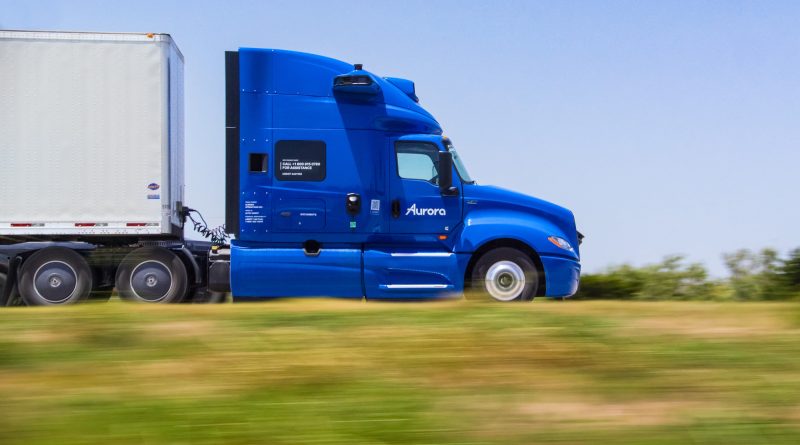
How Aurora plans to reach 30,000 autonomous trucks by 2030
Subscribe to our free newsletter today to keep up to date with the latest transportation and logistics news.
Aurora Innovation plans to have more than 30,000 driverless trucks operating by the end of 2030, a target that would take autonomous trucking from hundreds of vehicles to a large commercial fleet in four years.
The company expects to finish 2026 with about 200 driverless trucks. By the end of 2027, it expects that figure to exceed 1,000. Aurora is also targeting more than $5 billion in annual revenue by 2030 and a gross margin of about 60%.
Those numbers set a high bar. Yet Aurora argues that 30,000 trucks would still represent a small share of the wider heavy-duty truck market. CFO David Maday told TechCrunch that major truck manufacturers collectively produce between 250,000 and 300,000 new trucks each year.
For freight operators, the main question is whether Aurora can build an operating and financial model that supports deployment at that scale.
Aurora’s growth plan depends on changing who owns the trucks
Aurora currently operates what it calls Transportation as a Service. Under this structure, Aurora owns and operates autonomous trucks and charges customers about $2 per mile, including a fuel surcharge.
The model allows carriers and shippers to use driverless freight services without buying autonomous vehicles themselves. But Aurora does not plan to use this structure for most of its future growth. The company expects to limit the model to about 500 trucks.
Its larger opportunity rests on Driver as a Service. Under this model, fleet operators would buy and maintain autonomy-enabled trucks. Aurora would provide and support its autonomous driving system and charge customers a per-mile subscription fee. The company expects that fee to start at about $0.85 per mile.
Owning tens of thousands of trucks would require Aurora to finance a large fleet while carrying maintenance, fuel and operating costs. Moving ownership to customers would reduce that capital burden and place the trucks inside established fleet networks.
Aurora already has one sign of customer demand. Hirschbach plans to own and operate 500 Aurora-powered trucks, with deliveries expected to begin in 2027. Aurora said in September that it was also negotiating additional Driver as a Service agreements.
For autonomous trucking, this could change how the technology reaches the market. The autonomous driving system could become one part of the truck rather than requiring the technology developer to operate as a carrier.
Higher truck use could strengthen the business case
Fleet ownership is only one part of the equation. Autonomous trucks also need to produce enough economic value to justify their additional hardware, software and support costs.
The company says Aurora Driver-powered trucks operating for customers including McLane and Werner are averaging an annualized rate above 225,000 miles. Aurora says that is more than twice the utilization of a traditional truck.
Its investor presentation points to utilization of about 250,000 miles per year under the Driver as a Service model.
There is a practical reason autonomous trucks may support higher mileage. Human drivers are limited by hours-of-service rules and the need for rest. A truck without a driver in the cab could spend more of each day moving freight, although maintenance, loading, route availability and other operating limits still apply.
Higher utilization can improve the economics of an expensive asset. Fixed costs can be spread across more revenue-producing miles, while fleets may be able to move more freight with fewer trucks.
Aurora still needs to show that these economics hold as its fleet grows. The company expects to reach breakeven gross margin on a run-rate basis during the first half of 2027, when it expects roughly 500 driverless trucks to be operating. It then expects positive free cash flow on a run-rate basis by the end of 2028.
These are company forecasts, not established financial results.
Mass production will determine how quickly autonomous trucking grows
Aurora’s second-generation commercial hardware is designed for a 1 million-mile operating life while reducing hardware costs by more than half. Roush is handling volume upfitting and is targeting production of 20 trucks per week.
The larger manufacturing shift is expected with Aurora’s third-generation hardware. Partner Aumovio is set to manufacture, finance and service the hardware, while Aurora is also working with truck manufacturers to integrate autonomous systems more closely with production vehicles.
Volvo is already integrating the Aurora Driver into the VNL Autonomous at its New River Valley factory in Virginia. Aurora is also working with PACCAR on future factory integration.
This manufacturing model matters because retrofitting a few hundred trucks is very different from supplying tens of thousands.
Aurora reported more than 500,000 driverless miles since commercial launch as of Sept. 23. It also expects to have 200 trucks on the road by the end of 2026.
The next milestones should provide a clearer measure of whether autonomous trucking is ready for a much larger role in freight.
Reaching 30,000 trucks by 2030 would require Aurora to increase its fleet roughly 150-fold from its expected year-end 2026 level. That growth will depend on more than autonomous driving software. Fleet demand, manufacturing capacity, truck economics, hardware reliability and operating performance will all need to develop together.
For logistics executives, 2027 may matter more than the headline 2030 target. It is the year when Aurora expects to move beyond a company-owned fleet model and begin putting more of its technology into trucks owned by customers.
If that transition proves workable at scale, autonomous trucking could begin to look less like a limited technology deployment and more like a commercial option available to large freight fleets.
Source:
TechCrunch
Photo Credit:
Aurora