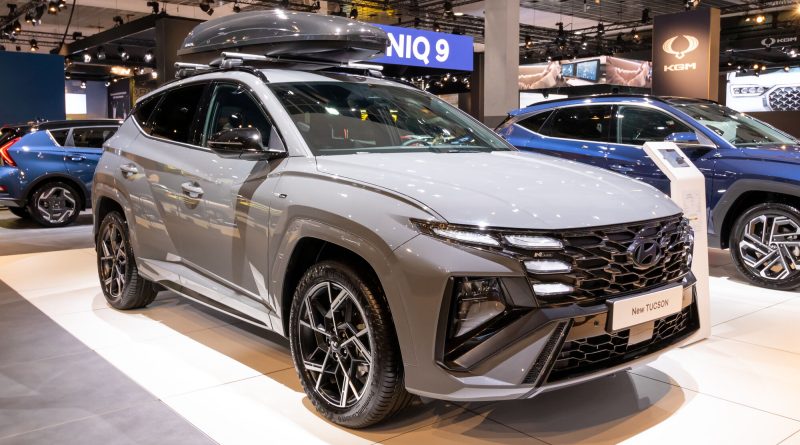
Hyundai puts hybrids at the center of its North America strategy
Subscribe to our free newsletter today to keep up to date with the latest transportation and logistics news.
Hyundai Motor is making hybrids a larger part of its North American growth plan as US buyers show stronger demand for fuel-efficient vehicles and slower interest in fully electric models.
The South Korean automaker plans to offer more than 10 hybrid models in North America by 2030. It expects hybrids to account for half of its regional sales. Hyundai will also add 500,000 units of manufacturing capacity in North America as part of a wider 1.27 million-unit increase in global capacity.
The plan links sales growth, local production and higher margins.
Hyundai raised its target for its consolidated operating profit margin in 2030 to more than 9%, compared with an earlier target of 8% to 9%. The company expects a broader hybrid range, lower material costs and more local sourcing to support that goal.
The expansion therefore goes beyond responding to changes in consumer demand. Hybrids are becoming part of Hyundai’s wider production and profit strategy.
Hyundai plans to launch or refresh more than 100 vehicles worldwide by 2030, including 58 in North America. It is also looking at segments where it has had a smaller presence, including midsize pickups and light commercial vehicles.
The wider question for the auto industry is whether hybrids are becoming a long-term part of the market rather than a short bridge to battery electric vehicles.
US buyers are giving automakers a reason to rethink the EV transition
Recent sales data helps explain Hyundai’s decision.
Hyundai Motor America said US hybrid sales rose 71% in the second quarter of 2026. Hybrid sales were up 67% in the first half of the year, helping the company record its best first-half US sales.
The trend extends beyond Hyundai.
Hybrids accounted for a record 16% of new US light-duty vehicle sales in the second quarter of 2026, according to data from Omdia published by the US Energy Information Administration. Battery electric vehicles accounted for 6%, down from 7% a year earlier.
Reuters reported that overall US hybrid sales rose 19% in the first half of 2026. It also cited Cox Automotive data showing that 56% of US vehicle shoppers said higher gasoline prices made them more likely to consider a hybrid.
The figures point to a market in which buyers want lower fuel use but may not be ready to switch fully to battery electric vehicles.
That has financial consequences for automakers.
Manufacturers have spent heavily on EV platforms, battery plants and new factories. If EV adoption grows more slowly than expected, some companies risk having more capacity than the market can support.
Hybrids give manufacturers another option. They can reduce fuel use without requiring drivers to depend on public charging. They also allow automakers to offer electrification across high-volume models while continuing to use much of their existing manufacturing and dealer infrastructure.
Hyundai’s second-quarter results show why that balance matters. The company reported record quarterly revenue of 49.22 trillion won, helped by hybrid sales and demand in North America. Operating profit, however, fell 20.8% from a year earlier, while its operating margin stood at 5.8%.
Reaching the higher 2030 margin target will therefore depend on more than selling additional vehicles. Hyundai will also need a stronger product mix and lower production costs.
Local production could matter as much as powertrain choice
Hyundai is pairing its product strategy with a larger effort to build vehicles and source parts closer to North American customers.
The company plans to raise local parts sourcing in North America to 80% by 2030, up from its previous 60% target. The region will also receive 500,000 units of additional manufacturing capacity.
Hybrids will be built at Hyundai Motor Manufacturing Alabama and Hyundai Motor Group Metaplant America in Georgia.
Greater localization can shorten supply chains and reduce exposure to some shipping costs and tariffs. It can also give Hyundai more control over how quickly it changes production as demand shifts among gasoline, hybrid and electric vehicles.
Trade policy remains a source of uncertainty. The review of the US-Mexico-Canada Agreement could affect the duty-free movement of vehicles and parts across North America.
That matters because vehicle production often depends on components moving across borders several times before a finished vehicle reaches the customer. More local sourcing can reduce some exposure, but it cannot remove the effects of regional trade policy.
Hyundai is also broadening its approach to electrification.
Its first Santa Fe extended-range electric vehicle is due in the first half of 2027 and will be built in Alabama. Hyundai expects the model to offer more than 600 miles of total range.
An extended-range EV uses an electric motor to drive the vehicle, while an onboard engine can generate electricity when needed. The format could appeal to drivers who want electric driving without relying entirely on charging infrastructure for longer trips.
Hyundai still expects electrified vehicles to account for 60% of global sales by 2030, up from 23% in 2025. Its broader target remains 5.55 million global vehicle sales by the end of the decade.
The strategy does not signal a move away from electrification. Instead, Hyundai is preparing for a market in which hybrids, extended-range EVs and battery electric vehicles may coexist for years.
That approach also gives Hyundai more ways to respond if consumer demand changes faster than expected.
For other manufacturers, the main lesson is the value of flexibility. Factories that can support several powertrains, supply chains with more local sourcing and product ranges that match different levels of EV demand could offer an advantage as the market changes.
Hyundai is betting that hybrids can support growth and margins while giving customers more choice during an uneven transition to electric vehicles.
Source