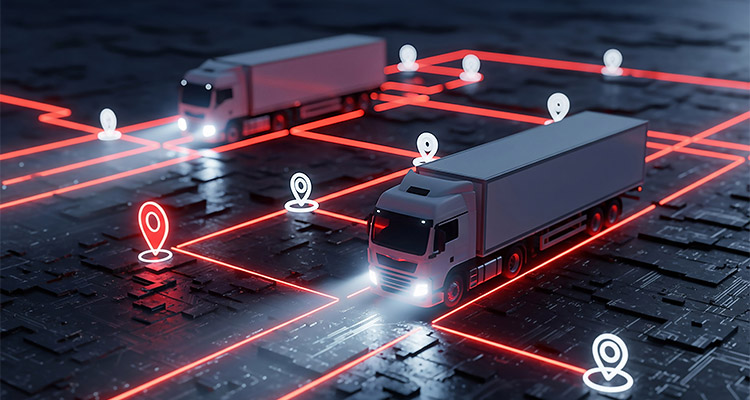
Ian Perotto, Chief Supply Chain Officer at Atlante, discusses turning visibility into resilience in an uncertain world
The past few years have underscored a simple truth for logistics leaders: resilience is no longer a desirable attribute of supply chains; it is an operational necessity. Geopolitical tensions, climate-related disruption, labor shortages, port strikes, congestion and fluctuating consumer demand continue to test even the most established networks. In this context, the concept of the ‘smart supply chain’ has moved rapidly from buzzword to business imperative.
Smart supply chains are not defined by a single technology, but by the intelligent integration of digital tools that enable greater visibility, faster decision-making and closer collaboration between people and machines along the “end-to-end” journey. From sensor-based monitoring and advanced Transportation Management Systems (TMS) to robotics and human–machine collaboration in warehouses, these technologies are fundamentally changing how logistics teams plan, execute, optimize and deliver the movement of goods.
Visibility as the foundation of smarter logistics
End-to-end visibility remains the cornerstone of any smart supply chain. Without a clear, real-time understanding of where products are, in what condition, and how they are progressing against plan, resilience is impossible to achieve.
Sensor-based monitoring technologies, including IoT devices and connected telematics, are playing an increasingly important role in closing long-standing visibility gaps. Sensors embedded in vehicles, containers or pallets can provide continuous data on location, temperature, humidity and shock events, allowing logistics teams to monitor the journey of goods in far greater detail than was previously possible and, in case it is possible, to tackle upfront any possible incidents (especially temperature-related).

Crucially, this data is no longer confined to retrospective reporting. Real-time alerts enable proactive intervention when something goes wrong, whether that means rerouting a shipment to avoid congestion, addressing a temperature excursion before product quality is compromised, or responding quickly to delays that could cascade through the wider network. In uncertain operating conditions, the ability to act early can make the difference between a minor disruption and a major failure.
The evolution of TMS: from planning tool to control tower
Alongside sensor technologies, developments in TMS are reshaping how logistics operations are managed. Traditional TMS platforms were primarily designed to support planning and execution. Today’s systems are evolving into digital control towers, offering centralized, real-time oversight across multiple modes, geographies and partners.
Remote control towers and live dashboards allow logistics teams to aggregate data from carriers, warehouses, ports and production sites into a single, coherent view. This not only improves situational awareness but also supports more informed decision-making under pressure. Scenario modelling and predictive analytics, increasingly powered by artificial intelligence, enable teams to assess the likely impact of disruptions and evaluate alternative courses of action before issues escalate.
Just as importantly, modern TMS platforms enhance accountability across the supply chain. Shared visibility helps align expectations between shippers, logistics providers and customers, creating a more transparent operating environment in which performance can be measured and continuously improved among all players in the chain.
Digitalization and robotics in the warehouse
Warehouses are another critical frontier in the development of smart supply chains. As volumes fluctuate and labor markets remain tight, digitalization and automation are becoming essential tools for maintaining efficiency and service levels.
Robotics is increasingly being deployed to support tasks such as sorting, picking, packing, palletizing and internal transport. Rather than replacing human workers, many of these solutions are designed to work alongside them, taking on repetitive or physically demanding activities while freeing people to focus on tasks that require judgement, dexterity or problem-solving.
This model of human–machine collaboration delivers multiple benefits. It can improve productivity and accuracy, reduce injury risk, and help warehouses adapt more flexibly to changes in demand. When combined with warehouse management systems and real-time data feeds, robotics also contributes to greater transparency and control within the four walls, feeding valuable information back into the wider supply chain.
Human–machine collaboration: augmenting decision-making
While automation and digitalization are often discussed in technical terms, the human dimension remains central to smart supply chains. Technology is most effective when it augments, rather than replaces, human expertise.
Advanced analytics and AI-driven tools can process vast quantities of data far faster than any individual, identifying patterns and risks that might otherwise go unnoticed. However, it is people who provide the context, ethical judgement and strategic oversight needed to translate insights into effective action.
As a result, investment in skills, processes and real change management is just as important as investment in technology. Organizations that empower their teams to work confidently with digital tools are better positioned to extract value from innovation and to respond creatively when faced with uncertainty.
Why smart supply chains matter for food and beverages
The case for smarter supply chains is particularly compelling in the food and beverage sector. Products are very often time- and temperature-sensitive, margins can be tight, and regulatory requirements are stringent. Any loss of visibility or control can have serious implications for quality, safety and brand reputation.
Sensor-based monitoring supports cold chain integrity by providing continuous assurance that products are being transported, handled, stored and distributed under the correct conditions. Real-time data can also simplify compliance and traceability, helping businesses demonstrate due diligence and respond quickly in the event of a recall.
At the same time, improved forecasting, warehouse automation and integrated planning tools can help food and beverage producers and distributors reduce waste, optimize inventory and better align supply with fluctuating demand. In an environment where sustainability is rising rapidly up the agenda, these efficiencies deliver both commercial and environmental benefits and both end up in a better service level and a better P&L, too.
From technology adoption to strategic capability
Ultimately, smart supply chains are not built through isolated technology projects. They require a strategic approach that aligns digital innovation with business objectives, operational processes and people.
As uncertainty becomes a defining feature of the global trading environment, the organizations that succeed will be those that view technology as an enabler of resilience, visibility and collaboration among parties with focus on suppliers and customers. By embracing sensor-based monitoring, advanced TMS platforms, warehouse digitalization and human–machine collaboration, logistics leaders can move beyond reactive disruption management towards truly adaptive supply chains fit for the challenges ahead.
Atlante is a global sourcing partner for food products, founded in Bologna (Italy) in 1994 by Natasha Linhart, CEO. The company was born from Natasha’s passion for food and her vision to create a new model to connect producers and retailers across borders. Atlante is a trusted service provider offering a comprehensive suite of solutions, from brand distribution and private label development to supply chain management. In 2025, the company generated €289 million in annual turnover, with the goal of reaching €312 million in 2026. In addition to the UK, a market thecCompany entered in 2015, Atlante operates in multiple European and non-European countries, including Switzerland, Japan and South Korea.