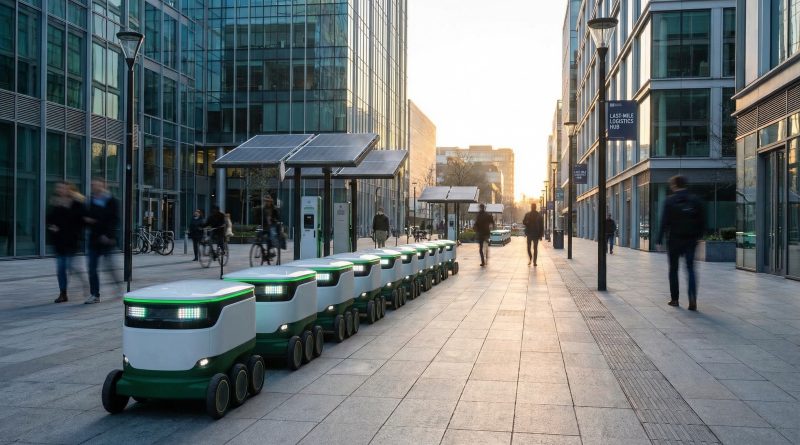
Inside the growing role of robotics in smart city logistics
Subscribe to our free newsletter today to keep up to date with the latest transportation and logistics news.
The economics of last mile delivery have become increasingly difficult to ignore. As e-commerce volumes rise, logistics providers face pressure to deliver faster while containing costs. The final leg of the supply chain now accounts for more than half of total shipping expenses in many cases, driven by urban congestion, fragmented delivery routes and labor constraints. Against this backdrop, autonomous delivery robots have emerged as a response to a defined operational problem.
Small, ground-based robots are now navigating sidewalks in cities across the US, Europe and Asia. Their presence remains limited but consistent. These machines are not designed to replace traditional fleets entirely. They are built to handle short-distance, high-frequency deliveries that strain existing systems. In dense urban environments, where efficiency is constrained by infrastructure rather than demand, robotics offers a different operating model.
Why last mile delivery remains the most complex segment of logistics networks
The last mile sits at the intersection of logistics and urban planning. It is where delivery promises meet physical limitations. Traffic congestion, parking restrictions and unpredictable demand patterns create inefficiencies that are difficult to scale. Labor shortages have added another layer of complexity, particularly in markets where delivery roles face high turnover.
Cost structures reflect these challenges. With up to 53 percent of shipping expenses concentrated in the last mile, even marginal efficiency gains can shift margins. Traditional delivery models rely on human drivers and large vehicles, which are not always suited to dense, short-range routes. Failed delivery attempts and idle time increase operational costs.
Consumer expectations continue to shift. Same-day and next-day delivery are baseline requirements. This demand compresses delivery windows and limits route optimization. As a result, logistics providers are testing alternative models that reduce dependency on centralized fleets and enable localized distribution.
How delivery robots are being deployed across urban environments
Autonomous delivery robots are being introduced in controlled, high-density settings where limitations can be managed. University campuses, residential developments and business districts have become testing grounds for scaled deployment. Companies such as Starship Technologies have completed millions of deliveries, focused on food and grocery orders.
These robots operate within a two to five mile radius. They rely on a combination of GPS, computer vision and sensor arrays to navigate sidewalks and avoid obstacles. Advances in AI allow adaptation to changing environments, while connectivity through 5G networks supports real-time coordination and monitoring.
In China, firms such as JD.com and Meituan have accelerated deployment across urban centers, integrating robots into broader logistics networks. In the US, pilot programs led by Amazon and other providers continue to test scalability in suburban and mixed-use environments. Deployment remains uneven across regions, but robotics is being positioned as a complementary layer within existing delivery systems.
The economics and sustainability case for autonomous delivery systems
From a cost perspective, delivery robots offer a targeted advantage. By automating short-distance routes, companies can reduce reliance on human drivers for low-margin deliveries. Estimates suggest that autonomous systems could lower last mile costs by up to 30 percent in specific use cases, particularly where delivery density is high.
The environmental case is also relevant. Most delivery robots are electric, producing lower emissions than traditional delivery vans. For short-distance trips, this shift can reduce carbon output and support sustainability targets set by cities and logistics providers.
The economic model depends on scale. Initial investment in hardware, software and infrastructure remains high. Return on investment improves as fleets expand and utilization rates increase. This dynamic favors large operators and urban environments where delivery volumes justify deployment.
Regulatory, social and operational challenges continue to shape adoption
Despite progress, several barriers remain. Regulation is fragmented, with cities and municipalities adopting different approaches to sidewalk usage and safety standards. This lack of consistency complicates scaling efforts, particularly for companies operating across multiple regions.
Public perception continues to evolve. Many users view delivery robots as convenient, but concerns around safety, accessibility and job displacement remain. Incidents involving vandalism or technical failure highlight the need for safeguards and clear accountability.
Operational limitations are also significant. Weather conditions, uneven terrain and complex urban layouts can disrupt performance. Robots are best suited to predictable environments, which limits their applicability in certain areas. Addressing these constraints will require continued investment in technology and infrastructure.
What delivery robots signal for the future of smart city logistics
The broader implication of delivery robotics lies in its alignment with smart city development. As urban areas invest in connected infrastructure, integration of autonomous systems becomes more feasible. Delivery robots can interact with traffic management systems, digital mapping platforms and IoT networks to optimize routes and reduce congestion.
This integration points to a more distributed logistics model. Instead of relying solely on centralized hubs, cities may adopt micro-fulfillment centers supported by autonomous delivery fleets. This approach reduces transit distances and improves responsiveness to local demand.
Over the next decade, the role of delivery robots is likely to expand, though not uniformly. Their impact will depend on regulatory alignment, technological maturity and economic viability. They represent a shift in how goods move through cities, introducing a new layer of flexibility into urban logistics systems.
Sources