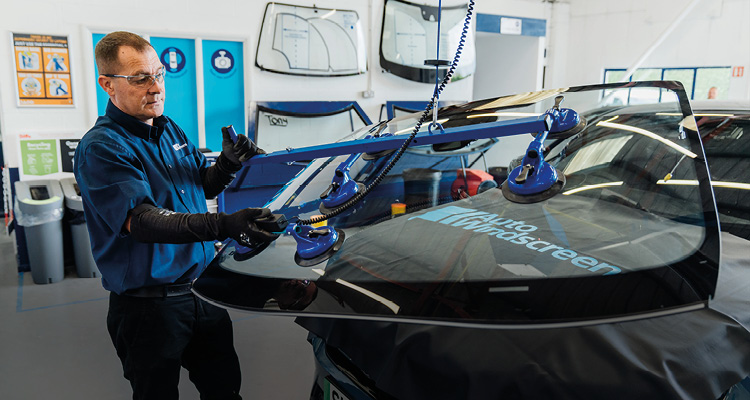
Learn more about Auto Windscreens’ efforts to get windscreen fitting recognized as a skilled trade
Established in 1971, Auto Windscreens is one of the UK’s leading automotive glazing and Advanced Driver Assistance Systems (ADAS) calibration specialists. Across the country, the company is a trusted name when it comes to glass replacement, windscreen repair and windscreen ADAS calibration services. We join James MacBeth, Managing Director, to discuss the company’s services and dedication to advancing the industry as a whole.
“Originally, we provided windscreen repair and replacement across the UK and Northern Ireland through service centers and mobile technicians. That’s what we still do, with the addition of an ADAS calibration service. We were one of the first companies in the industry to establish a training academy, which we set up back in 1990. What has remained consistent throughout our history is our focus on safety, quality and customer service. Every day, our teams help ensure vehicles return to the road safely, a responsibility we take extremely seriously,” he begins.
Standardizing ADAS calibration across the industry remains one of the biggest challenges Auto Windscreens is working to overcome. “The biggest issue facing our industry is consistency,” James states. “Vehicle manufacturers have developed an enormous range of ADAS technologies, and traveling up and down the country, I see all these wonderful new vehicles coming through with phenomenal capability, which is great for customers. But governance around calibration, technical competency and ongoing maintenance has not evolved at the same speed, and that has resulted in significant variation in how calibrations are carried out across the industry. That is why our work with the Department for Transport and the Parliamentary Advisory Council for Transport Safety (PACTS) is so important. We are pushing for proper regulation, because there is growing recognition of just how significant the safety benefits of this technology can be, but only when supported by robust standards, technician competency and genuine public confidence. Technology is evolving at an unbelievable pace. We are currently at Level 2 vehicle autonomy, but the industry is already looking towards Level 5, which encompasses fully autonomous vehicles that essentially drive themselves. That is exactly why regulation matters so much, and why we are committed to sticking to the highest standards. We were one of the first in the UK industry to be IMI accredited as a training school, and we registered with European Security-related Vehicle Repair and Maintenance Information (SERMI) before the scheme was officially launched in the UK on 1 April 2026. It’s for these reasons we are considered one of the leading businesses in our sector.”
Auto Windscreens’ commitment to raising standards extends beyond the business itself. Back in April, James hosted a dinner with parliamentarians and key industry stakeholders in the House of Commons to among other things, address industry-wide skills shortages, pushing for greater uptake of apprenticeships and for windscreen fitting to be formally recognized as a skilled trade. One of the biggest misconceptions about the sector is that windscreen replacement is a simple task, hence why it is currently classed as ‘semi-skilled’, despite the reality of the work involved. The company is actively working to correct this misconception, because the level of precision required for this type of work today is remarkable. When James began his career as a windscreen technician in 1992, vehicles were fitted with simple rubber gaskets. Today, a windscreen can account for up to 40 percent of a vehicle’s structural integrity. Getting glass fitted and ADAS calibrated correctly is vital, which is precisely why the company is pushing for the role to be formally recognized as a ‘skilled’ profession, like motor mechanics rather than ‘semi-skilled’.
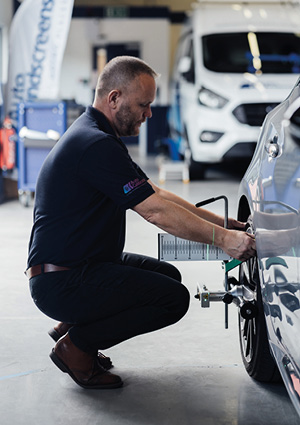
“Connecting into the vehicle’s technology is a critical part of getting ADAS calibration right. Our job is not just about fixing a warning light on a dashboard but about identifying underlying ADAS errors that could point to a safety risk. We’re also working towards attracting more talent into our sector,” James continues.
Looking ahead, Auto Windscreens is preparing to launch one of its largest projects to date, an 18-month collaboration with IFS Cloud involving substantial investment in both systems and ADAS equipment. With ADAS developing incredibly fast, staying ahead of the curve is essential for the company. Customers increasingly expect real-time updates, seamless journeys and greater transparency throughout the repair process, and Auto Windscreens is investing significantly in systems designed to improve that experience while also operating more efficiently. Alongside that, the company is continuing to invest in the latest ADAS equipment, recognizing that many of today’s vehicles come fitted with sophisticated lidar, radar, lane-change control and mirror sensor systems, all of which demand the right calibration technology.
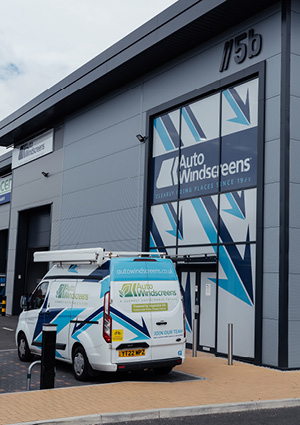
As Auto Windscreens continues to grow its nationwide presence, it remains committed to balancing that expansion with environmental responsibility, as James highlights. “We are constantly looking at ways to optimize vehicle routing, reduce unnecessary journeys, improve resource utilization and minimize waste across the UK. Our commitment to sustainability runs through the business, which is why we always promote repair over replacement wherever possible. We also recycle glass removed at a rate of 100 percent, and we invest in digital systems to reduce paper usage and improve operational planning. As a nationwide provider, transport emissions are naturally a key area of focus for us, particularly given everything happening with costs across the industry right now. That is why we are opening more dedicated sites that will enable us to operate more efficiently, especially when it comes to ADAS,” he concludes.
As vehicle ADAS systems advance, Auto Windscreens is pushing the entire industry to take calibration as seriously as the technology demands. The company firmly believes that recognition, regulation, sustainability and proper training are where the future of the sector lies.