McAllister Towing is building the fleet that modern shipping actually needs
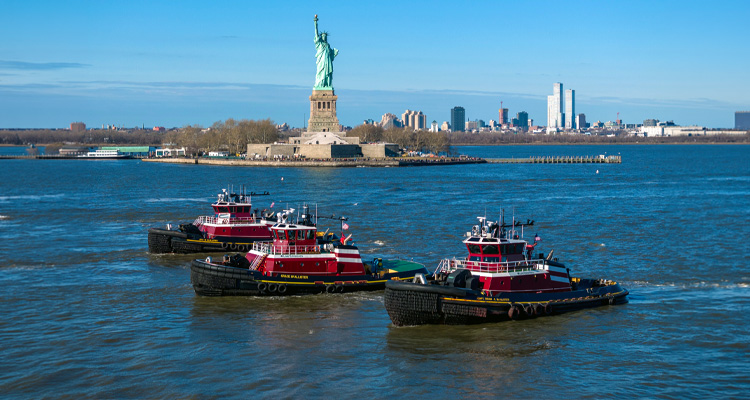
With a fleet of more than 60 tugboats, crew boats, and barges in 13 locations along the US East Coast, McAllister Towing (McAllister) expertly delivers ship docking, general harbor towing, coastal towing, windfarm support and bulk transportation.
“Our company was founded in 1864 in New York City, moving parcels of cargo around the harbor by sailboat. The founder was my great-great-grandfather, James McAllister, who emigrated from Northern Ireland during the Civil War and kept reinvesting in the business to take us where we are today. I am a fifth-generation descendant of James, and we are now starting to bring some sixth-generation family members into the business as well,” Buck McAllister, President, begins.

As the fifth generation in charge, Buck’s role involves balancing the legacy that those before him worked hard to build while ensuring the business remains relevant and competitive for the generations ahead. That balance has required some bold decisions, such as a significant investment in tugboat infrastructure that went against the grain of what customers were actively requesting at the time. “Our mission is to be the best company in the boat business, and we do that by keeping our fingers on the pulse of the industry. The reality is that large 80 metric ton tugs had not been frequently requested by customers, who were focused on keeping operations as efficient and cost-effective as possible. However, we could see that the scale of shipping was increasing and that bigger tugs were going to be needed. So we went ahead and built ten 80 metric ton tugs. This significant investment in tugboat infrastructure makes us one of the only companies in America with a fleet of such high-horsepower vessels. We anticipated the needs of our customers and invested in being able to meet them, and at this point we are very proud of the fleet we have built and the services we can now offer,” he reveals.
Today, the business is structured across three main areas. Roughly half is tugboat ship assist, with a fleet of around 70 tugboats based at local operations stretching from Eastport, Maine, down the entire East Coast to Port Everglades, Florida, and across to San Juan, Puerto Rico. Then, around a quarter of the business is a ferry operation, where McAllister runs four ferryboats back and forth between Bridgeport, Connecticut and Port Jefferson, Long Island, under the self-explanatory name the Bridgeport and Port Jefferson Steamboat Company. The remaining quarter covers diverse activities, including ocean towing, launch operations and a barging division. Beyond operations, McAllister has also acquired numerous parcels of land to support its tugboat endeavors, and is increasingly operating marine terminals for both cargo operations and vessel repair, alongside lay berths and marina facilities.
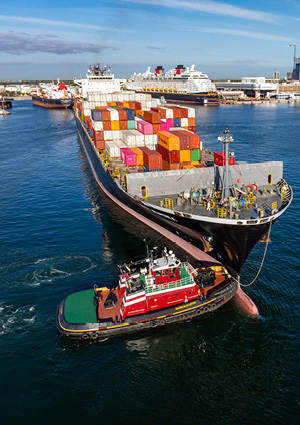
While the maritime industry experiences new shifts and trends, McAllister aligns its priorities and plans accordingly. For instance, container ships in New York that once reached 5000 TEU and around 800 feet in length have given way to vessels of 900 feet carrying 8000 TEU, and now to ships stretching 1300 feet with capacity for 18,000 TEU. Major operators such as Mediterranean Shipping Corporation, Hapag-Lloyd and CMA CGM are now building vessels at 20,000 TEU. As a direct response to that trend, McAllister is looking to push the larger freightliners and ferry side of the business by investing in high-powered tugs.
On the ferry side, the company is equally focused on growth and modernization. “A year ago, we took delivery of a brand-new ferry called the Long Island, which significantly increases our capacity while being entirely modern. It is a low-emission Tier 4 vessel that is environmentally sustainable and marks a step forward in passenger comfort,” Buck elaborates. “We have also been completely changing the terminal on the Port Jefferson side. As part of that, we recently built two new office buildings so that we can demolish the existing terminal and expand capacity there. In Bridgeport, Connecticut, we have purchased 20 acres of land where we are working on building a new ferry terminal. This new site will meaningfully improve capacity and the passenger experience on that side of the crossing.”
Alongside these infrastructure developments, McAllister is also investing in the people who will crew these vessels in the years to come. The company has a long history of training mariners and an enduring relationship with the State University of New York (SUNY) Maritime College at Fort Schuyler, employing over 50 people who hold university degrees from the school and being a consistent financial supporter of the institution. That relationship is now being formalized in a meaningful way. Following discussions with the school’s administration, McAllister pledged $2.5 million towards the maintenance and upgrade of SUNY Maritime College’s computer simulator systems, with the aim of raising the standard of training available to the next generation of mariners. In July, McAllister will put a new cohort of its own employees through a training program at the facility, further developing their navigational skills on some of the most advanced simulator equipment available. However, that facility will not be limited to McAllister staff, as it will be available to any member of the public who approaches SUNY Maritime to use their simulators, making the investment a benefit to the wider industry rather than simply to one company.
For 160 years, McAllister has secured its success and stayed ahead of the competition by anticipating where shipping is heading before customers ask, building tugs before they are demanded and investing in the people who will crew them long before any shortages force it to. Thinking several moves ahead has proven a successful strategy for the family business, with an even brighter future ahead.