
Spring Global Delivery Solutions powers cross-border e-commerce with sustainable and AI-driven logistics
Leveraging its unparalleled creative expertise in cross-border logistics, Spring Global Delivery Solutions (Spring GDS) specializes in providing the most efficient and hassle-free delivery solutions. Countless e-commerce businesses worldwide trust Spring GDS for reliable logistics support. To learn more about the company’s purpose and its strategies for staying ahead of the competition, we spoke with Kelly van der Weg, Managing Director of Spring GDS UK.

“In essence, we are an international B2B2C e-commerce company specializing in global shipping solutions. We combine postal and commercial networks in order to support sellers and make it as convenient as possible to ship their international consumer goods. Although we are fully owned by PostNL, the Dutch postal provider, we operate independently, allowing us to leverage their networks, contracts and capabilities when they fit our proposition. Through this collaborative approach, we help each other enhance our market presence while also maximizing procurement efficiencies and scalability benefits,” he opens.
Enhanced service delivery
As an asset-light company, Spring GDS’s most important strengths are its people and its intelligent IT and e-commerce platform. This platform serves as the cornerstone of Spring GDS’s technology, boasting 80 integrations with its marketplaces and related elements. Additionally, the platform connects carriers while enhancing transparency for customers. Not only can customers use the platform for tracking, tracing and order management, but it is also accessible to staff across any of Spring GDS’s facilities across more than 20 countries, fostering interconnectivity. As a result, international sellers operating from multiple locations can integrate into Spring GDS’s network, benefiting from a standardized approach through the same platform.
Through this interconnected platform, Spring GDS benefits from enhanced service delivery and collaborates more effectively with specialized partners who bring essential expertise to its operations. Due to its asset-light model, the company relies on strategic partnerships with specialists. “Our working methodology usually involves collaboration between Spring GDS teams across various countries and a central team in the Netherlands, which focuses on developing generic solutions applicable to all Spring GDS locations. However, we also engage specific partners that are particularly important for the UK market, such as AEB,” Kelly reveals.
To deliver a seamless integration and logistical experience, the company leverages the specialized knowledge and assets that its partners bring to the table. Among its many industry partnerships, AEB serves as a valuable technology partner, playing a vital role in enriching its data and creating seamless integration flows. AEB assists the firm with customs clearance and building its manifests, integrating directly with local customs systems. Being in the UK means that Spring GDS often processes clearances via the Netherlands, and AEB’s integration with local customs is invaluable. “AEB provides specialist support that helps us build our customs knowledge. This is especially crucial as we are up against significant changes this year, including new EU legislation. All these regulatory changes need to be translated into our systems to make sure that the money flows through and that the data is compliant. AEB is essential in helping us meet these evolving requirements,” Kelly continues.
Sustainability strategy
As Spring GDS navigates these challenges, its commitment to sustainability has also been central. “Sustainability is not just a commercial tool for us; it is a belief intertwined in our DNA. We are dedicated to taking responsibility for our planet, striving to meet the highest possible standards. PostNL has committed to achieving Net Zero by 2040, and as part of that organization, it is only logical for us to follow this ambition. We don’t just set goals, we create a concrete plan to achieve them. On a micro scale, we are making strategic investments, such as a local focus on the exclusive use of renewable energy, implementing proper waste management practices and operating a fully electric vehicle fleet in the UK. On a macro scale, we have invested in renewable fuel, notably hydrotreated vegetable oil (HVO 100). We have also developed custom, reusable pallet boxes to replace hundreds of thousands of single use pallets. Their ergonomic design ensures optimal loading efficiency within our network. After approximately seven uses, these reusable plastic pallet boxes become more sustainable compared with single‑use cardboard packaging,” Kelly enlightens.
Empowering people
Josie Andrew, Marketing Manager, further elaborates on Spring GDS’s latest sustainability initiatives. “At the end of last year, we launched our book-and-claim solution for sustainable aviation fuel (SAF). We already utilize HVO 100, which positively impacts our road networks, and we are also starting to use it for shipments traveling by air. While a significant portion of our network operates across Europe via trucks, we are now incorporating sustainable practices for parcel deliveries that require air transport. Our SAF initiative is going to be a central part of our sustainability reporting this coming March.”
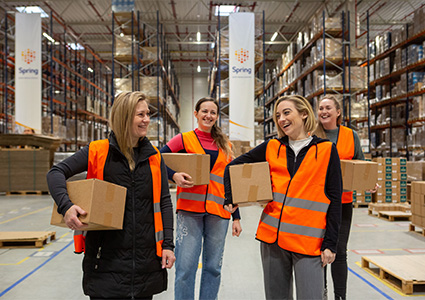
In recent years, many logistics providers have implemented AI to boost speed and cost efficiency. Yet, while the technology excels at processing data and highlighting anomalies, it lacks the one element that defines excellent logistics service: human connection. Recognizing this caveat, Spring GDS leverages AI as a tool to empower its people rather than replace them. “Despite our investments, it is vital for us to maintain a personal touch in our communication and that our customer service and sales teams are always directly approachable. Nonetheless, we use AI in three key areas. In our logistical context, it serves as a simulation tool to identify optimal pivot points within our networks. We also employ AI in Salesforce to assist our business development and key account managers in searching for suitable customers, particularly in scenarios where we believe we may add value to specific clients. These AI tools provide our customers with insights into customer traffic sources, what potential they could convert and so forth. With this intelligence, we can educate our customers and be specific about how we can add value to their business.
“The third area involves our reliance on postal and commercial networks, along with our hubs and trucks. Internally, this extensive network creates significant complexity, so AI helps us accurately pinpoint the whereabouts of items, allowing us to address customer service inquiries and identify any anomalies within the network. Although we utilize AI primarily on the backend to make the lives of our employees easier, it is important to emphasize that it has not replaced any jobs, nor is that its intent,” Kelly concludes.