Tesla ends Cybertruck production to make room for its Cybercab
Subscribe to our free newsletter today to keep up to date with the latest transportation and logistics news.
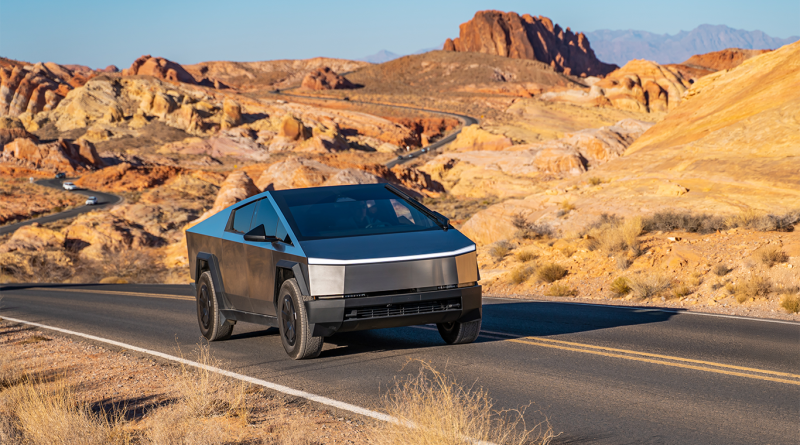
Tesla plans to wind down Cybertruck production at Gigafactory Texas by around the middle of 2027, freeing space at the plant for its Cybercab self-driving taxi.
Chief executive Elon Musk announced the change in a social media post on Nov. 6, saying the move would make room for increased Cybercab production. Gigafactory Texas is the only plant that builds the Cybertruck, so the decision sets an end date for the stainless-steel pickup itself. Tesla has not said whether another factory could take it on.
The timing follows a long slide in demand. Tesla does not report sales by model, but Kelley Blue Book estimates that Cybertruck sales fell 48% between 2024 and 2025, then dropped a further 28% in the first 9 months of 2026.
For transportation and logistics readers, the significance lies less in the pickup than in what Tesla is choosing to build instead. Factory capacity is finite, and Tesla is giving part of its Texas plant to a vehicle designed to carry passengers without a driver.
The Cybertruck never reached the volume Tesla needed
Introduced in 2019, the Cybertruck arrived with a design unlike anything else in the pickup segment. It drew enormous attention at launch, but that attention did not turn into lasting sales.
The truck has also faced quality problems and numerous recalls since it went on sale. Each recall adds cost for the manufacturer and chips away at the confidence of buyers who expect a pickup to work hard and reliably.
For commercial users, reliability is the deciding factor. Pickups are often bought as work tools by contractors, utilities, and fleet operators who judge vehicles on uptime, service support, and total cost of ownership. A truck with a reliability question mark, and a design that is harder to fit into standard fleet operations, faces a narrow path into those buyers’ budgets.
The sales estimates suggest the Cybertruck never broke out of its early niche. A 48% fall in a single year is steep for any vehicle, and a further decline through 2026 shows the slide had not leveled out.
Gigafactory Texas is being repurposed for autonomy
Musk’s reasoning puts the Cybercab at the center of Tesla’s manufacturing plans.
The Cybercab is Tesla’s purpose-built self-driving taxi. By moving factory capacity toward it, Tesla is signaling that it sees autonomous ride-hailing as a bigger opportunity than a niche electric pickup.
That is a significant bet. A robotaxi business depends on regulatory approval, public acceptance, and the ability to run fleets safely and profitably at scale. None of those outcomes is guaranteed, and the timeline for large commercial deployment remains open.
Freeing capacity in Texas gives Tesla physical room to build the Cybercab quickly if demand materializes. In manufacturing terms, the company is trading a product with shrinking demand for one whose demand has yet to be proven.
The decision is also a reminder of how carmakers weigh dedicated production lines for electric models. A product that fails to reach scale becomes hard to defend when the same floor space could serve a program with a stronger strategic case.
Fleet operators will want answers on support and resale
For fleets that bought Cybertrucks, the wind-down raises practical questions. Operators will want clarity on parts availability, service support, and resale values once the truck is no longer in production.
The larger question is what the Cybercab could mean for transportation more broadly. If Tesla can build autonomous vehicles at volume, it could change the economics of urban passenger transport and, over time, put pressure on ride-hailing and taxi operators that rely on human drivers.
Several questions remain open. The announcement did not include production targets for the Cybercab, and Tesla has not said whether any other plant will build the Cybertruck after mid-2027. It is also unclear how quickly the Texas factory can shift its focus.
What Tesla has made clear is that it values its Texas floor space more for driverless taxis than for electric pickups. Whether that judgment pays off depends on a vehicle the market has not yet tested at scale.
Source
KTTC