Tesla Semi is here. Can electric trucking scale with it?
Subscribe to our free newsletter today to keep up to date with the latest transportation and logistics news.
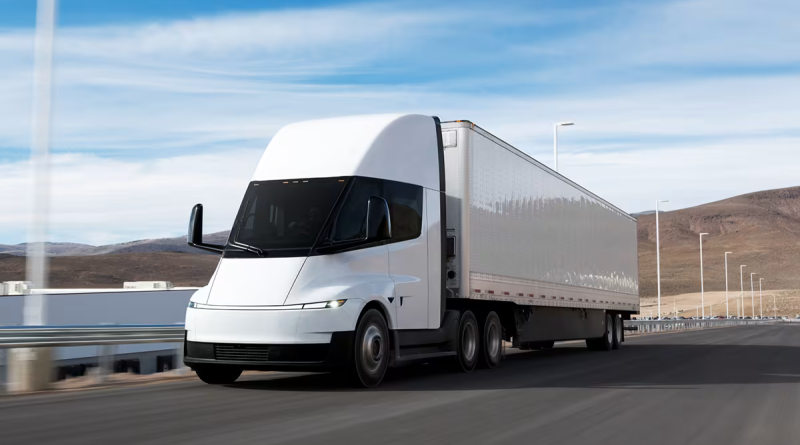
Nearly nine years after Tesla first showed its electric Semi, the company has started high-volume production of the Class 8 truck at its factory in Sparks, Nevada.
The launch moves the Tesla Semi from a long development program into a much larger commercial test. Tesla is targeting fleet operators with two versions. A standard model will offer an estimated 325 miles of range, while a long-range version is designed for about 500 miles.
Tesla lists energy consumption of 1.7 kWh per mile and charging capability of up to 1.2 MW. The company says deliveries will begin in 2026.
Demand is also moving beyond small trials. In September, CALSTART announced that Tesla had been selected as the main supplier for a 2500-truck order from ZET SCALE, a shipper alliance. CALSTART described it as the largest electric Class 8 truck order in US history and said it could nearly double the number of electric Class 8 trucks on US roads.
That gives Tesla a chance to test more than the Semi’s technical specifications. Fleet managers now need evidence that an electric truck can deliver the range, uptime and operating costs required for daily freight operations.
Tesla is moving electric trucks beyond short regional routes
Battery-electric trucks have so far been well suited to predictable routes where vehicles return to a depot for charging. Regional distribution, port operations and short-haul freight fit that model well.
The Tesla Semi is designed to extend those limits.
Its estimated 500-mile maximum range is more than double the typical range offered by some established electric Class 8 trucks. Freightliner lists its eCascadia with typical ranges of 155, 220 or 230 miles, depending on battery and axle configuration.
A 500-mile truck could allow fleets to consider battery power for routes that have been difficult to serve with existing electric vehicles. It could also reduce the need to charge during a driver’s shift on some routes.
Fleet operators, however, will need more than a range figure.
Payload, terrain, temperature, traffic and driving style can all affect energy use. A truck that can travel 500 miles under one set of conditions may perform differently on a demanding freight route with a heavy load.
High-volume production should create a much larger pool of operating data. That information could matter more to fleet operators than any launch specification.
Operators need to know how much energy a truck uses on their routes, how often it needs charging, how long it stays in service and how its performance changes over several years.
The electric truck market also remains relatively small. CALSTART reported that zero-emission trucks accounted for 4.14% of US truck deployments during the second half of 2025, up from 1.32% during the first half.
The Semi will therefore enter a market that is growing but remains at an early stage.
Charging could determine how quickly fleets can scale
Longer range addresses one barrier to electric trucking, but large batteries also require large amounts of power.
Tesla says the Semi can charge at up to 1.2 MW through its Megacharger system. That level of charging could help fleets return trucks to service sooner, but installing high-power charging can require major electrical upgrades.
Public infrastructure is growing, although the network remains limited.
CALSTART said in May that its national infrastructure map included about 162 public, semi-public and shared charging or hydrogen facilities across 17 states. Those sites included about 1500 charging plugs for medium- and heavy-duty vehicles, along with 32 hydrogen refueling nozzles.
For many fleets, depot charging may remain the simpler option. Trucks can return to a known location, recharge during planned downtime and begin the next shift with a full battery.
That model becomes harder as routes get longer or operations depend on trucks staying on the road for extended periods. A national electric freight system will need reliable charging along major transport corridors as well as at depots.
WIRED reported that Tesla had two public Semi charging locations in the Los Angeles area when the truck entered high-volume production, with plans to increase that number to 30 by the end of 2026.
The gap between vehicle production and charging availability could shape the rate of adoption. Fleets may be able to buy electric trucks faster than utilities can provide new high-power connections.
For that reason, electrifying a truck fleet can become an energy and infrastructure project as well as a vehicle purchase.
Fleet economics will decide how far the Semi can go
Tesla’s strongest argument may be financial rather than environmental.
The company says the Semi can cost less to own than a comparable diesel truck over time because electricity can cost less than diesel and electric drivetrains need less maintenance. Local incentives may also reduce costs for some operators.
The economics will depend heavily on how each fleet operates.
Electricity prices, diesel costs, charging equipment, financing, incentives, annual mileage and vehicle use can all change the calculation. A truck that covers many miles each year may give an operator more opportunity to recover a higher purchase and infrastructure cost through lower running expenses.
The 2500-truck ZET SCALE order should provide a larger test of those economics. It could generate operating data across a wider group of commercial routes rather than a small number of demonstration fleets.
The order should still be separated from actual deployment. Trucks have to be built, charging equipment has to be installed and fleets have to integrate the vehicles into daily operations before the financial results become clear.
After nearly a decade of development, the Semi is moving into a different phase. Tesla has shown that a battery-electric Class 8 truck can cover long distances. High-volume production will test whether thousands of those trucks can deliver predictable range, uptime and costs in everyday freight operations.
That question will be answered as much by fleet balance sheets as by miles driven.
Source:
WIRED
Photo Credit:
Tesla