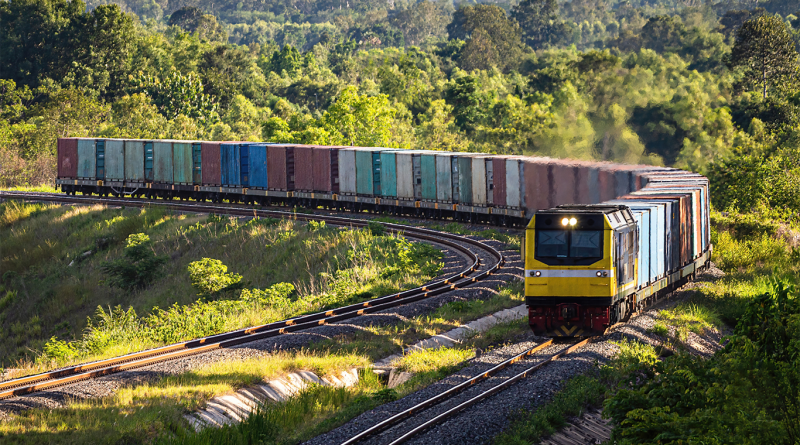
The top 8 rail freight innovations improving efficiency
Rail freight has a compelling efficiency proposition. A single train can move large volumes of cargo over long distances, while reducing the number of individual vehicle movements required. Yet much of the sector still contends with processes and equipment developed for an earlier industrial era.
That is beginning to change. Automation, sensors, artificial intelligence and new propulsion systems are reshaping how freight trains are assembled, inspected, operated and maintained. In Europe, the transformation is particularly significant because digitalisation is increasingly being approached as a network-wide project rather than a series of isolated upgrades.
These eight freight innovations show where the largest operational gains could emerge.
1. Digital automatic coupling
Few technologies demonstrate the contrast between old and new rail freight as clearly as digital automatic coupling, or DAC.
Many European freight wagons still use screw couplings that require workers to manually connect wagons. DAC automates mechanical and pneumatic coupling while creating continuous power and data connections through the train.
That second capability is important. Europe’s Rail describes DAC as a foundation for the Full Digital Freight Train, allowing information about cargo, wagon condition and destination to move through an interconnected system. It can therefore support technologies ranging from automated brake testing to monitoring and train preparation.
The technology is moving beyond theory. In 2026, Europe’s Rail reported progress integrating DAC and a consist control unit into a Stadler EuroDual locomotive, while extensive testing has continued across the industry.
2. Autonomous freight trains
Autonomous rail freight is already operating at industrial scale.
Rio Tinto’s AutoHaul network in Western Australia provides one of the clearest demonstrations. The mining company can operate as many as 53 fully autonomous trains simultaneously across its roughly 2,000-kilometre Pilbara network. Each train comprises 240 wagons and can carry around 28,000 tonnes of iron ore.
Automation eliminates driver handovers that previously required trains to stop during journeys. It also allows movements to be coordinated centrally, helping operators improve line speeds, reliability and network utilisation.
The model cannot simply be replicated on every mixed-traffic railway. But AutoHaul demonstrates what becomes possible when automated train operation, communications and centralised traffic control are treated as one system.
3. Intelligent video gates
A freight train entering a terminal normally requires inspection before the next stage of its journey. Intelligent video gates aim to perform much of that work while the train is moving.
Systems being developed in Europe combine high-frequency cameras with technologies including RFID readers, wheel sensors and machine learning. They can identify wagons and loading units while collecting information that supports inspections and damage management.
Europe’s Rail estimates that intelligent video gates could reduce wagon check times by up to 20 percent, terminal staff costs by up to 50 percent and, in some applications, terminal loading times by up to 50 percent.
Live demonstrations continued in Germany in 2026, while a Spanish demonstrator is testing integration between video gates and onboard sensors in a high-traffic terminal environment.
4. Predictive maintenance
Traditional maintenance is often based on fixed time or mileage intervals. Sensors and data analytics create an alternative: maintain equipment according to its actual condition.
Network Rail has trialled intelligent wagon technology capable of detecting overloaded or unevenly loaded wagons, hot brakes and locked axles. Alerts can be transmitted to operators and maintenance teams, potentially allowing problems to be addressed before they create failures and delays.
Other trials have combined vibration monitoring with machine learning to build health profiles for wagons and components. This changes maintenance from a scheduled intervention into an increasingly predictive process.
5. Smart wagon tracking and telematics
A freight wagon may spend weeks moving between terminals, customers, sidings and national networks. Knowing precisely where it is, what condition it is in and whether it is loaded can substantially improve asset utilisation.
Research into digital freight wagons has demonstrated systems combining continuous positioning with sensors for train composition, integrity and asset monitoring. Data can be transferred to remote systems for analysis and visualisation.
SNCF’s MONITOR project takes the concept further, using onboard sensors to measure variables including brake pressure, axle temperature, vibration and train configuration. The objective is not simply tracking. Connected wagons can support faster preparation, predictive maintenance and fewer unplanned stoppages.
6. Real-time yard and network management
Making an individual train faster achieves little if it subsequently waits for a path, terminal or marshalling operation.
Digital network management tackles that problem by bringing information from trains, yards and infrastructure together. Instead of reacting to disruption after it occurs, operators can use current information to adjust activities and capacity.
Europe’s Rail has developed a yard and network management platform for proactive operational planning. Its research indicates that combining technologies such as automatic train operation and coupling with digital management could improve total yard lead times by 20 percent and reduce costs by 10 percent.
For rail freight, this may prove as important as innovation aboard the train itself. Better coordination allows existing infrastructure to handle traffic more effectively without necessarily adding new tracks.
7. Battery-electric locomotives
Rail freight is already comparatively energy efficient, but diesel traction remains important on non-electrified routes. Battery-electric locomotives offer operators another way to reduce fuel use without requiring every kilometre of track to be electrified.
Wabtec demonstrated the potential with its FLXdrive battery locomotive in California. Operating with diesel locomotives in revenue service, the battery locomotive used regenerative braking and intelligent energy management. The trial produced an average reduction of more than 11 percent in fuel consumption and greenhouse gas emissions for the entire train.
Battery locomotives could be particularly valuable where full overhead electrification is difficult or uneconomic, including yards, ports and selected freight corridors.
8. Distributed power and smarter train formation
Efficiency is also being improved by reconsidering where traction comes from.
Instead of relying solely on locomotives at the front, distributed power places traction at different points in a train. Deutsche Bahn says its distributed power system can increase traction power by one-third with a locomotive at the front and another at the rear, while doubling energy recovery and enabling longer, heavier trains.
The commercial logic is straightforward. Moving more cargo with each train can reduce the number of train movements required for a given freight volume, improving use of infrastructure, crews and energy.
Taken together, these freight innovations point toward a railway that operates less like a collection of mechanical assets and more like an integrated logistics platform. Couplers become data connections, wagons become sensor networks and terminals become automated information points.
The biggest efficiency gains may therefore come not from any single invention, but from connecting them. A digitally coupled train with intelligent wagons, predictive maintenance, automated inspection and real-time network management creates something more valuable than eight independent technologies. It creates a rail freight system capable of seeing, interpreting and responding to its own operations.