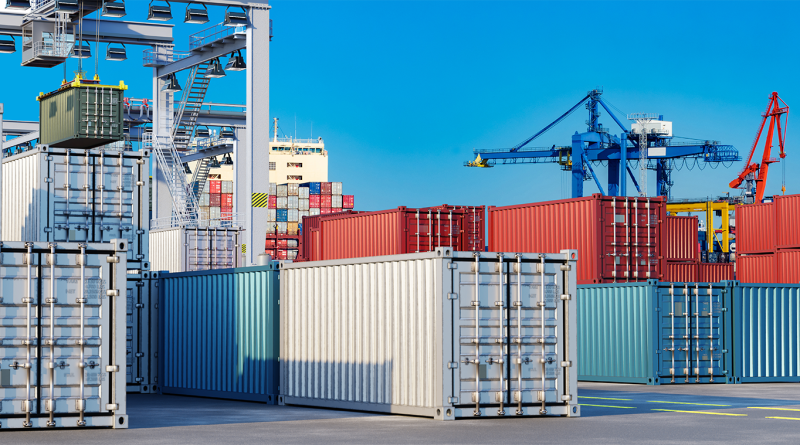
US container imports hit 2026 high as peak season winds down
Subscribe to our free newsletter today to keep up to date with the latest transportation and logistics news.
US container imports climbed to about 2.37 million TEU (twenty-foot equivalent units) in September, the highest monthly total of 2026, as retailers continued to bring in goods during an unusually long peak season.
The figure, reported on Nov. 9 in the Global Port Tracker published by the National Retail Federation (NRF) and Hackett Associates, was up 12.6% from a year earlier and 3.4% from August. It came in about 90,000 TEU above the 2.28 million TEU the tracker had forecast for the month.
September was the third-busiest month since the tracker began keeping records, behind 2.4 million TEU in May 2022 and 2.39 million TEU in July 2025.
The report also points to a slowdown ahead. NRF expects volumes to fall steadily through the end of the year and into 2027, with March forecast to drop 11.2% from a year earlier.
US container imports stayed high through an extended peak season
Global Port Tracker covers major US gateways on the East, West, and Gulf coasts, including Los Angeles, Long Beach, New York and New Jersey, Savannah, and Houston.
Peak season, the run of heavy imports ahead of the holiday shopping period, usually builds through late summer and early autumn. This year it lasted longer. Changes in US tariff policy repeatedly shifted the timing of shipments as retailers tried to move goods ahead of new duties.
According to Hackett Associates, an import surge that began in 2025 appeared to be easing earlier this year after the US Supreme Court struck down the administration’s sweeping tariffs. New tariffs introduced in the second quarter then set off another wave of imports from May through mid-October.
“U.S. ports have seen high volume levels throughout this year’s longer-than-usual peak season,” said Jonathan Gold, NRF vice president for supply chain and customs policy. “Nonetheless, most holiday merchandise is already here.”
Gold also said some West Coast ports have seen cargo held for long periods while waiting to be transferred to rail, a sign that heavy volumes have put pressure on inland connections as well as on the docks.
NRF forecasts declines into early 2027
The tracker estimates October imports at 2.26 million TEU, up 9.1% year over year. It then expects volumes to settle at about 2.05 million TEU in November and 2.03 million TEU in December, up just 1.2% and 1.3% respectively from a year earlier.
Forecasts weaken in the new year. NRF forecasts January at 2.04 million TEU, down 3%, February at 1.89 million TEU, down 0.5%, and March at 1.92 million TEU, down 11.2%.
For 2026 as a whole, the tracker now projects 26 million TEU, up 2% from 25.4 million TEU in 2025. That is an upward revision from the 25.8 million TEU NRF forecast in October. The first half of the year totaled 12.7 million TEU, up 1.1% from the same period of 2025.
Consumer demand has helped hold volumes up. Ben Hackett, founder of Hackett Associates, said consumer spending supported the influx, with households continuing to buy despite rising inflation.
Carriers and ports face a quieter start to the year
For ocean carriers, the shift from a long peak to a softer start to 2027 could put pressure on freight rates on the transpacific and other import lanes, as fewer bookings chase the same vessel capacity.
Ports and inland operators face a different adjustment. After months of high volumes and rail backlogs at some West Coast ports, a slower first quarter could give terminals and railroads time to catch up. It could also mean less work for the drayage carriers and warehouses that have been handling the surge.
Retailers, meanwhile, will be judging whether the inventory they brought in early matches what consumers actually buy over the holidays.
Several questions remain open. US tariff policy is still changing, and any new duties could trigger another round of front-loading that disrupts the forecast. For now, NRF’s numbers suggest the long peak season is drawing to a close, and the first months of 2027 will show how much of this year’s strength was demand and how much was timing.
Source
National Retail Federation