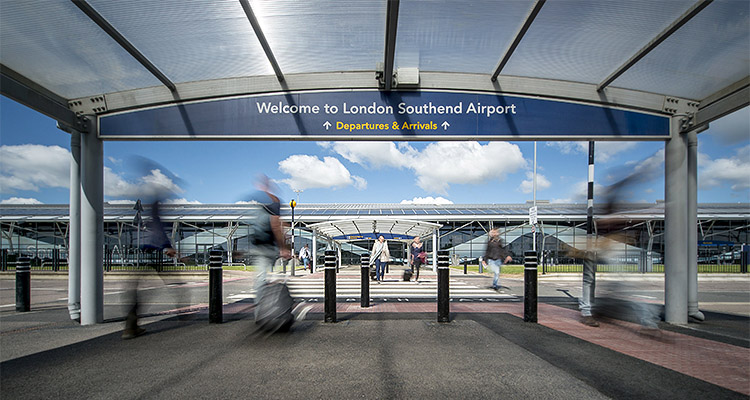
With a new CEO at the helm, London Southend Airport seamlessly serves increasing passenger numbers
Described as a ‘challenger airport’ by The Telegraph in December 2025, London Southend Airport (London Southend) is one of six international airports serving London, which is the world’s largest aviation hub by passenger traffic. However, despite being the UK’s fastest growing airport according to official UK CAA statistics for 2025, what sets London Southend apart is the passenger experience on offer.
Located in Southend, the airport’s terminal infrastructure is designed to provide a simple, positive experience for passengers – think fast check-in, small security queues, and reaching London in 52 minutes via six direct trains every hour. Having undergone significant investment between 2008 and 2012, the airport reached a total of two million passengers in 2019, but the Covid-19 pandemic brought devastating consequences for the aviation industry, and London Southend was no exception.
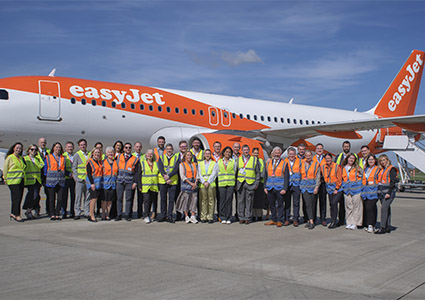
When we spoke with Nigel Mayes, Business Development Director, at the end of 2024, London Southend remained in post-pandemic recovery mode, but operations were steadily increasing. easyJet’s return to the airport solidified London Southend’s position in the London aviation market, offering passengers more sustainable aircraft and an array of exciting destinations.
Around 18 months later, London Southend has a new CEO, Jude Winstanley. After 30 years in the aviation industry spanning roles with British Airways and IAG Group, as well as freight, commercial, and consultancy experience, Jude brings a wealth of expertise, passion, and drive to the airport. Transportation & Logistics International sits down with Jude to chat about what has defined his first year in the role.
“The people and community here at London Southend are incredible, and that’s just one reason why it’s been such a fantastic first year as CEO,” Jude opens. “2025 has been a great year for the business too, with the planned easyJet base launch at the end of March 2025 driving a whole range of projects and generating positive feedback from both the airline and its passengers.
“We’ve almost tripled our passenger volume, from 250,000 to around 720,000 passengers per year. To cope with this growth, we’ve hired an additional 170 people to increase our team by around 50 percent. Through all of this, our safety record, overall operational performance, and customer experience have all improved. London is also an important market for business aviation, and our Jet Centre has also grown significantly, with around 20 percent year-on-year growth in the last year.”
Having recruited significantly, Jude is clearly passionate about maintaining the right number of people as the airport’s passenger numbers continue to grow. “We ensure new recruits are security vetted and properly trained, but it’s also important to give people time to get used to the culture without feeling rushed,” he says. “We’re really blessed in terms of where we are in the world, as we’re right on the doorstep of Southend. A large majority of our workforce, specifically around 85 percent, live in a Southend postcode, and are what I describe as hyperlocal employees, with many of our team members walking to work.
Employee engagement
“There’s a real sense of community among our people and this translates to our passenger experience, with many passengers commenting that staff are genuinely happy in their work. Aside from successfully delivering our recruitment and retention strategy, we always look for feedback and make small adjustments that ensure our people not only feel listened to but also genuinely cared for. One of my greatest joys is taking a walk around the airport, whether it’s the terminal, the fuel farm, or the Jet Centre, to engage with people and share our love for the business.
“From a customer feedback perspective, we monitor results from our passengers using interactive displays throughout the airport,” Jude explains. “We track responses using a mobile app, and all the executive team have the app downloaded to their phones to track responses in real time. Since the easyJet base launch in 2025, we’ve also received lots of positive feedback in terms of easyJet’s customer satisfaction scores.”
Summer and winter schedule
On the topic of easyJet, our conversation turns to the success of the airline’s based operation at London Southend. “easyJet is now entering the second year of its based operations, which is maturing every day,” Jude says. “After a successful year, the airline continues to make improvements and additions to the network. easyJet started to serve Berlin and Barcelona in October 2025, for instance, as well as extending its schedule for flights to Geneva. Later this year, the airline is launching three new routes – Munich, Jersey and Ibiza – which will mean a total of 25 easyJet routes operated from London Southend.
“easyJet serves a great mix of summer and winter holiday destinations to ensure a busy schedule throughout the year. London Southend has a heavy winter flying program, and we’re working with easyJet to optimize our route network. The airline also operates a high proportion of holiday packages at London Southend compared to other UK airports, and to balance the offering, it also offers a range of city breaks, which typically cater to a slightly different demographic.”
With passenger experience a top priority, London Southend is constantly refining processes to enhance efficiency and overall experience. “We’ve got some excellent tech across the airport, especially with our new security machines, and we have a strong ongoing investment strategy to continuously optimize terminal operations,” Jude explains. “We’ll eventually need to add new security lanes and support the terminal’s overall infrastructure, probably by around 2028, to meet the demands of additional passengers and ensure the terminal flows well. As passenger numbers grow, we don’t want our terminal to be at full capacity but rather to remain a relaxed, spacious area where passengers can shop, get something to eat or drink, and prepare for their flight in a positive frame of mind.
“Our car parks are fantastic and close to the terminal. To improve the reliability and speed of car parking, we’re in the process of introducing barrierless car parking systems, and we’re also adding a new express lane to enhance our convenient pick-up/ drop-off area directly opposite the terminal entrance.”
Green strategy
While passenger experience remains a top priority, London Southend is also passionate about minimizing its impact on the environment. “Around 25 percent of our electricity is provided by our on-site solar farm, and I’m keen to increase this output,” Jude says. “We’re talking to a couple of companies about upgrading the battery provision of our existing panels, and we’ve prepared funding for further solar capability around the airport, as I’d like to see London Southend move towards producing more than half our used electricity from renewable sources. Aside from renewable energy, we’ve made changes like shifting our lighting to LED and encouraging electric vehicles where possible, and although they might seem like small changes, they make a big difference when added together.
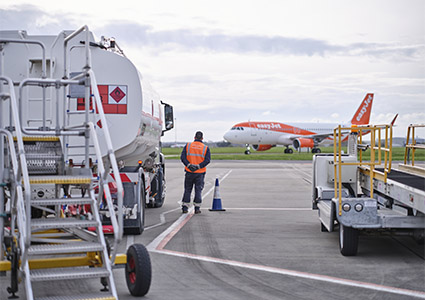
“In terms of SAF, we have our own fuel farm on site, and we can provide a particular approach for our customers in line with regulation. The adoption of SAF is either customer or legislation driven, and my job is to provide what our customers need in the most effective way possible, while being compliant with the direction of UK policy and regulation.”
With a maturing easyJet base, ongoing infrastructure enhancements, and a strong commitment to both environmental and social responsibility, London Southend is more than a challenger airport – it is a positive space that is redefining passenger experience in the London aviation market. Under Jude’s leadership, the airport will inevitably continue to scale operations in line with increased passenger numbers while preserving the ease of experience valued by its passengers.
“We’re always trying to perform better in terms of safety and customer satisfaction while also targeting growth, as we’re on track for a further 30 percent growth in 2026,” Jude states. “We’re currently recruiting for our summer season, and we’re quietly confident that 2026 will be an improvement on 2025. Our investments in infrastructure and network routes will become clearer later in the year, and this will create a launchpad for our success in 2027 and beyond.
“It’s important that any CEO has high ambitions, and our owners are equally passionate about developing the airport; London Southend is a great place, and we want to be the best airport in London,” Jude concludes. “I want to push passenger volumes past three million people, be known for running the most efficient operation, and employ happy and engaged staff. Most importantly, regardless of how much we grow, I want to maintain our position in providing the best customer experience for any UK airport.”