
Garrets International marks 35 years by reshaping maritime food supply through data, scale, and a crew-focused approach
Garrets International (Garrets) celebrates its 35th year amid rising costs, new regulations, and evolving crew expectations in maritime supply chains. Since its founding in 1991, the organization has grown into a global leader in provisions and stores management, serving vessels through an integrated network that links sourcing, logistics, and onboard systems. The anniversary marks both a milestone and an era of transformation in how food supply supports life at sea.

Managing Director, Hamish Cook, steers the global Garrets organization, while Business Development Director, Julian Baldey, drives commercial growth and external customer engagement. Together, they’re responding to shipowners and managers who now expect greater visibility, control, and support from their supply partners.
Hamish is direct about the priority for the past 18 months: “Our main focus has been adding value for our customers and the vessels we serve. We’ve expanded our team’s culinary and logistics expertise, and we’ve continued to invest in our digital platforms to make life easier for crews on board.”
Systems and scale
Garrets has rebuilt its core systems to match the way crews work on board, making ordering, stock control, and reporting more efficient and less time-consuming. “We simplified our stocktaking module and added multi-device functionality to the platform. Our stakeholders on board tell us it now takes much less time to manage orders and receive provisions,” Hamish explains.
“Over the last 35 years, we’ve seen a huge shift in how vessels connect with us. As owners have introduced Wi-Fi across most of their fleets over the past 15 years, this has helped us streamline operations and build closer relationships with cooks and masters. Now, they can make better decisions with more information on pricing, budgeting, nutrition, and sustainability,” he notes.
Data now sits at the heart of how Garrets supports customers. The company uses AI-driven nutritional analysis to better understand consumption patterns across fleets, gaining deeper insights into nutrition and greenhouse gas emissions. This helps Garrets meet reporting needs and support crew health and sustainability.
Food and welfare
Food is still at the heart of life on board, shaping crew routines, health, and morale. Garrets has put extra focus on culinary support to reflect this. “In the last year, we strengthened our culinary development team by adding a senior manager who leads recipe, menu, and vessel support,” Hamish shares. Garrets partners with cooks to balance cost, preferences, and consistency across vessels, using data to guide decisions over time. “We collaborate with cooks to develop menus that align with budgets and crew preferences. The nutrition data we collect helps our culinary team ensure that our recipes support positive health and well-being for crews.”
While Hamish focuses on the global strategy and operations, Julian looks at growth and the company’s external market positioning, considering the impact of provisioning on crew experience and performance. “Our thought leadership comes from real operational experience and a sense of responsibility to seafarers,” Julian explains. Their focus centers on understanding the realities of life at sea and responding with insights that make a tangible difference, rather than relying on theory. “We share practical, evidence-based perspectives that improve life on board, especially in nutrition, well-being, and retention. Better nutrition drives physical and mental resilience, which supports welfare, performance, and staff satisfaction,” Julian highlights.
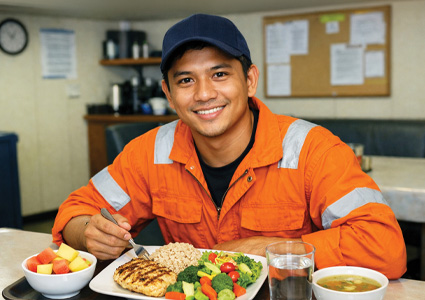
The alignment between data, food, and wellbeing reflects a shift in how provisioning is viewed, from a supply function to part of a wider system that supports crew outcomes. Healthy, high-quality food on board enables shipowners and managers to improve crew productivity, reduce crew turnover, and create a better onboard experience. The result is lower operating costs, greater crew satisfaction, and improved vessel performance.
Network and responsibility
The Garrets model depends on a supply chain that balances reach with consistency. The company operates across an established global network of over 900 port locations while maintaining control over food safety, product quality, and sourcing standards. Julian sees the company’s structure as core to its value for customers. “Our outsourcing model combines global scale with local delivery, backed by an integrated, accredited supply chain. Every supplier goes through independent audits to ensure that food safety meets international standards. We centrally manage sourcing, procurement, and logistics across a global network, so everything stays aligned and consistent, no matter where a vessel sails. That saves time, reduces risk, and gives customers confidence in their food supply,” he points out.
For shipowners and operators, it removes the burden of managing procurement across regions with different standards and risks. It also brings sustainability into the same structure through integrated purchasing data. “We deliver detailed purchase reports that show greenhouse gas emissions for each vessel in a customer’s fleet. We analyze this data and compare it to benchmarks, often down to individual product categories. We’ve also teamed up with partners in the Nordics to help key stakeholders on board make changes to menus and procurement practices that cut emissions,” he comments.
Linking reporting with training allows those insights to influence behavior on board rather than remain at a reporting level.
Next stage delivery
Looking forward, Garrets’ direction centers on simplifying the interaction between onboard teams and its systems. The aim is to reduce challenges in daily tasks while expanding access to information.
“In the near future, we’re committed to making processes even simpler for onboard crews. Their work is demanding; they serve meals every day at sea, so we put simplification first in every decision. We’re also exploring how to incorporate more AI to assist cooks as they place orders, making the process even smoother,” Hamish observes.
Alongside digital development, Garrets continues to explore ways to change how food is managed during voyages, including solutions that allow vessels to produce certain items on board.
Looking further ahead, Hamish describes a vision built on access to information and consistency across the supply chain. “Our long-term goal is to become the go-to source for all information on food procurement, production, and consumption. We want crews to get the right food, wherever they are, and to help our customers give people at sea a better experience,” he concludes.
This technological evolution is helping Garrets connect supply, data, and onboard decision-making, bringing together systems that once worked in silos across vessels and shore teams.